


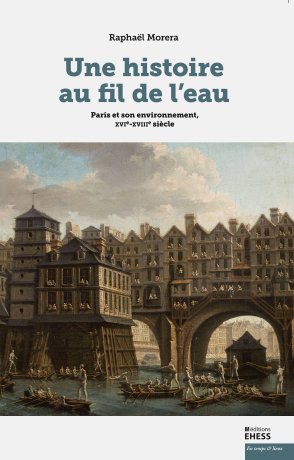
Between the sixteenth and eighteenth centuries, as the monarchy established its authority across French territory, the rivers of the Paris Basin continued to be managed by various actors through negotiations aimed at coordination.
A historical cruise through Paris’ rivers
About: Raphaël Morera, Une histoire au fil de l’eau. Paris et son environnement, XVIe-XVIIIe siècle, Éditions de l’EHESS
About: Raphaël Morera, Une histoire au fil de l’eau. Paris et son environnement, XVIe-XVIIIe siècle, Éditions de l’EHESS

|
Historians and geographers alike have shown how valuable and representative the water question is for understanding societies and their political choices. From the Rhine, which Lucien Febvre studied during the interwar years, [1] to the Columbia, the river examined in The Organic Machine, a landmark in American environmental history, [2] the study of great waterways is a classic topic that brings together different historiographical traditions. Though Raphaël Morera reminds us of this fact, his book undertakes a different project: he explores in one well-defined region – the Ile-de-France in modern times – the many waterways that flow into the Seine, upstream and downstream from Paris.
By blending a variety of archival sources, including those of the French government’s “waters and forests” administration, major landowners such as religious institutions, and the regulations that appeared with the establishment and strengthening of various institutions, Morera proposes a journey through Ile-de-France society over three centuries. We encounter the legacy of ancient hierarchies, which gave an important place to secular and religious seigneuries, as well as the monarchy’s rising power, which promoted collaboration between residents who lived along waterways. Morera dubs this principle “environmental subsidiarity,” that is, the delegation of waterways oversight.
Consistent terrain, varied practices
The Paris Basin is a space that has long been marked by a several factors, such as extensive cereal cultivation and the growth of the royal demesne around Paris. Across this relatively consistent terrain, there existed, as Morera explains, a variety of cooperative practices that emerged along different waterways. There was no uniform solution: “water’s energy and motor power were negotiated on specific territories” (p. 218).
Potential interlocutors included the monarchy, as mediated by various institutions, notably the water and forests administration, whose medieval origins ensured it a degree of legitimacy even as its role expanded over the sixteenth and seventeenth centuries. Yet even the agents of the water and forests administration never sought to impose uniform rules. Rather, they sought to ensure that each waterway benefited from coordination between different actors that would limit conflict, ensure regular dredging so that water could flow (which is essential for navigability and milling), and allow payments to be collected for the entrepreneurs who, by the eighteenth century, were increasingly contracted for public works.
Even as the monarchy’s power rose, several equally longstanding institutions maintained some authority, which varied from river to river. For instance, the Paris provost of merchants prioritized the navigability of waterways to ensure the city was well supplied – a necessity on which urban power has been historically based. Similarly, secular and ecclesiastical seigneuries were the primary owners of windmills, which were leased to millers, who acquired the right to use them and the duty to maintain them. Millers were thus charged with the maintenance of the river segment corresponding to their machines, which required them to dredge the riverbed and preserve the banks.
The book’s broader narrative concerns the rise of royal authority, of which the water and forests administration’s growing capacity for action was only an aspect. Until the seventeenth century, this administration was simply a judicial authority, charged with regulating disputes initiated by residents. Beginning in the eighteenth century, royal officials, by issuing regulations, increasingly acted like a bureaucracy. Even so, this trend was not the same on every waterway. On the Croult, a small river (now partly covered) that flows into Seine at Saint-Denis, the monks of the powerful Saint-Denis Abbey were long able to defend their mills and impose waterworks that served their interests – even defending them, at times, with armed men.
Disputed waters
Yet this approach, which emphasizes the role of dominant actors, only comes into focus as one gets deeper into the book. Morera primarily considers the many different residents who lived along the banks of the Ile-de-France’s waterways. Millers get a whole chapter, which examines the social structure of this very homogeneous group, whose members were organized into a kind of cursus honorum, starting with windmills or the mills of Charenton and ending with the mills of Paris. Sometimes one family network divided up the mills along an entire waterway.
As for artisans, they were not a new presence, but as users their number was growing. A wide range of artisans, from tanners to laundry workers, were to be found, according to a 1750 report, along the heavily parceled banks of the Bièvre – another that is now buried (chart 4, p. 115). They shared the banks with brewers, dyers, and market gardeners, as well as baths located along the rivers. Along other rivers, however, it was more common to find winegrowers, though in some cases millers who engaged in multiple occupations participated directly in certain agricultural activities.
The story of conflicts between actors recurs throughout the book. Since the development of medieval sources, urban settings faced the classic problem of water pollution by butchers, tanners, and other artisans who disposed of raw materials in the waters in which others washed, fished, and gathered. One also finds the inevitable rivalry, which has been documented since antiquity, between irrigators and millers. An argument repeatedly invoked by these actors is prior presence, which was viewed as a source of legitimacy. This can be seen in the case of a lord responding to the agents of the water and forest administration, as well as that of a tanner’s wife who was caught red-handed by a miller observing from a ladder as she dumped waste into the Bièvre. Her response? “You’re too new to stop me” (p. 211).
Ile-de-France society was changing, yet without major upheaval – save for the growth of industry with the support of mercantilist policies (and growing military needs), another sign of royal power. Moreover, the scattered settlement of riverbanks seen along the Bièvre in 1750 was not universal: at the time, most of the river was occupied by the Gobelins residence and manufactory. Paris’ growth pushed consumption upward (the city grew from 200 to 600 thousand inhabitants from the sixteenth to the eighteenth centuries, and the fiscal region to which Paris belonged consisted of two million residents on the French Revolution’s eve). During these years, the trade bureau offered entrepreneurs special privileges and “good spots” to benefit from hydraulic energy, which was increasingly needed.
Conflict explains sharing
Without taking on all the topics the book addresses, from the development of doubling grinding in milling to the amount of water that decorative basins for wealthy homes drew from rivers, it is worth considering how Morera situates his work in the field of environmental studies.
As he reminds us, it is through regular and well-documented conflict between residents, landowners, and users, which has occurred since the Middle Ages that the conditions for sharing water were established. This conclusion is also valid for many other regions: “across the European continent, the maintenance of hydraulic infrastructure necessitated the creation of ad hoc institutions that would coordinate the action of various water users” (p. 174). Citing the now quite extensive historiography on these questions, Morera makes several comparative points. Northern Italy stands out in particular, as city-states like Milan and Venice took charge of managing waterways in their rural areas early on. [3] Another center for water management in Europe was the Dutch countryside, which had undergone major transformations since the late Middle Ages. Drainage occurred thanks to coordination among landowners, including the aristocracy and church institutions. By the thirteenth century, these efforts have given rise to hydraulic institutions, which played a role in territorial organization.
In this landscape, the Ile-de-France’s specificity is to be found in the role played by the monarchy in creating the environmental commons [4] that were jointly managed rivers. The book considers in detail the example of the waters and forests administration encouraging the Bièvre’s residents to send a representative to whom certain tasks could also be delegated. In this instance, “jurisdictional regulations yielded to a different form of regulation, which was contractual in character and based on environmental subsidiarity” (p. 185). In this context, representation was not spontaneous, but “requested and institutionalized.”
Through comparisons with the work of Clifford Geertz and the more recent studies of Olivia Aubriot on other world regions, Morera considers what early modern Ile-de-France’s hydraulic organization tells us about the kind of society it was. Most importantly, it was characterized by “the rise of the monarchical state and the strengthening of its authority” (p. 226). The organization of how water was shared thus respected ancient rules as well as the stature of current actors, particularly the king and noblemen. Beneath the increasing adaptation of waterways to human needs due to population growth and the consumption needs of a nearby capital lay a world in which change was slower, more gradual, and negotiated.
Raphaël Morera, Une histoire au fil de l’eau. Paris et son environnement, XVIe-XVIIIe siècle (A historical cruise: Paris and its environment, 16th-18th centuries), Paris, Éditions de l’EHESS, 2024, 304 p., €23, ISBN 9782713233838.
by , 17 March
Share this article
Find us here :


To quote this article :
Pauline Guéna, « A historical cruise through Paris’ rivers », Books and Ideas , 17 March 2026. ISSN : 2105-3030. URL : https://laviedesidees.fr/A-historical-cruise-through-Paris-rivers
Nota Bene:
If you want to discuss this essay further, you can send a proposal to the editorial team (redaction at laviedesidees.fr). We will get back to you as soon as possible.
You might also like



Footnotes
[1] Lucien Febvre, Le Rhin. Histoire, mythes et réalités, Paris, Perrin, 1997 [1935].
[2] Richard White, The Organic Machine: The Remaking of the Columbia River, New York, Hill and Wang, 1996.
[3] Élisabeth Crouzet-Pavan and Jean-Claude Maire Vigueur, Water-Control in Western Europe, Twelfth-Sixteenth Centuries, Milan, Université Bocconi, 1994.
[4] This is the term Morera uses to refer to jointly managed rivers: “from this perspective, rivers are commons as economists, after many debates about their functioning, define them,” (p. 158).
Our partners


Sections
Keep in touch
© laviedesidees.fr - Any replication forbidden without the explicit consent of the editors. - Mentions légales - webdesign : Abel Poucet