


At a time of increasing appeals for moderation and lifestyles more respectful of nature, a new book proposes an original approach: to use the concept of asceticism to grasp practices of voluntary renunciation as a kind of spiritual experience.
Virtuoso Fasting
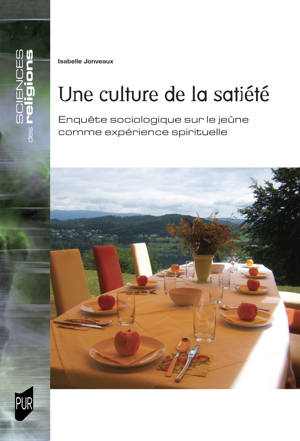
About: Isabelle Jonveaux, Une culture de la satiété. Enquête sociologique sur le jeûne comme expérience spirituelle, Presses Universitaires de Rennes
About: Isabelle Jonveaux, Une culture de la satiété. Enquête sociologique sur le jeûne comme expérience spirituelle, Presses Universitaires de Rennes

|
What is the contemporary fate of asceticism, that key feature of religious virtuosity (Weber, 1995)? This question is the starting point of Isabelle Jonveaux’s research. Jonveaux is a sociologist of religion at the Institut suisse de sociologie pastorale (Swiss Institute of Pastoral Sociology). Her book is premised on two empirical claims: first, that asceticism has declined in monasteries (Jonveaux, 2018), and second, that corporeal disciplines are on the rise in secular society. Jonveaux has decided to study “secular asceticism,” which refers to practices that involve “forms of abstinence and restriction to obtain spiritual results” (p. 11) “that are not situated in institutional religious structures and do not directly respond to an institutional command” (p. 41). Why, in a secularized society, do people place restrictions on themselves? This work, which lies at the intersection of the sociology of religion, the sociology of consumption, and economic sociology, focuses on one ascetic practice in particular: fasting, that is, partial or complete restrictions on eating, which can extend to new communication technologies, and even to cars. Fasting can be practiced at group events (week-long fasts, hikes, goum, [1]Alphalauf, [2] and so on) or at home.
The book is based on an ethnographic study that relies on interviews and observation, mostly in Austria but also in France at various fasting retreats between 2012 and 2016. To a lesser extent, it draws on a questionnaire filled in by fasters, observation of a fasting-themed Facebook group, and fasting handbooks.
Secular asceticism as spiritual experience
The goal of the book’s first chapters is to define, delineate, and situate secular asceticism in relation to monastic asceticism. We learn that asceticism, a recurring feature of monastic life reserved for virtuosos, has, since the late twentieth century, been in decline, both as a practice among monks and nun and in the discourse of the Catholic church. Specifically, fasting has disappeared gradually from monastic life. Meanwhile, new forms of fasting aimed at a secular audience have grown.
Monastic and secular asceticism share several common features: the secular ascetic practices the book studies belong to the Christian tradition, draw on practices of the monastic world, and refer to key figures of monastic asceticism, such as the Desert Fathers. Fasting retreats, moreover, often take place in monasteries. Even so, secular ascetic practices differ from those of monastic asceticism. First, ascetic secularism is a temporary and extraordinary practice that breaks with daily life (particularly through fasting retreats). It is a “temporary abandonment of the world” (p. 71). Furthermore, secular forms of fasting share a new conception of the body, based on wellbeing. Through fasting, one seeks to feel better, physically and spiritually. Finally, the communal organization of retreats subjects the group to social control and individuals to a disciplinary regime. Secular ascetic practices can, moreover, lead to practices that are more radical than monastic asceticism, such as breatharianism. [3] Forms of secular asceticism thus draw their legitimacy from the Catholic tradition and virtuosic fasting practices, while giving them new meaning and intensity, drawing on other spiritual traditions, such as Buddhism, as well as extra-spiritual practices, like those borrowed from medicine (as with the Buchinger-Lützner fast, invented by doctors).
Fasting is seen as a spiritual experience, the outcome of a personal project that individuals experience subjectively: the practice of fasting is constitutive of spirituality. It seeks to purify body and soul—that is, to free the body of corporal impurities and consumer society’s excesses so as to attain one’s authentic self and return to inner clarity. Fasters associate this catharsis with a new beginning. Secular ascetic practices can thus be described as “inherently religious experiences” (p. 161).
Who fasts?
The subsequent chapters paint a social and spiritual portrait of fasters. The practice of fasting is heavily gendered. Most fasters are women. In fasting retreats, fasters are characterized by high levels of economic and cultural capital. Those who fast at home are more socially diverse. It is worth emphasizing that while fasting retreats aspire to erase social differences through shared ascetic endeavors, the forms of asceticism practiced in such retreats can become a way to distinguish oneself and fasting can become ostentatious. Fasters also share a notable interest in alternative foods (such as vegetarian or vegan diets and organic foods) and spirituality. They share ecological values centered on the return to nature. Finally, many have experienced recent crises or instability in their personal lives. They claim to experience high levels of subjective religiosity, particularly during retreats. These “daily virtuosos” (p. 89) choose to fast, whether at retreats or at home, for different reasons: to reconnect with nature, purify themselves, pursue a spiritual quest, free themselves from the burdens of daily life, lose weight, or simply out of curiosity.
These motivations vary in relation to the fasters’ religious affiliation, but they share similar spiritual resources, such as a holistic approach to life. From this standpoint, fasting seeks to unify three levels: the body, the soul, and the spirit. Even so, fasters differ in how closely they embrace other spiritualities and in their ties to institutional religion. In these ways, fasting practices belong to an “elastic spiritual framework” (p. 146) that arises on a shared Catholic breeding ground.
The critique of consumer society
Secular ascetic practices participate in the critique of consumer society and its offshoots. Fasters see them as a way of recovering a sense of control (which they believe they have lost), and even as a way of withdrawing from consumer society. Fasters are highly reflective about their consumption practices, and recognize three responsibilities: to themselves, the human environment, and the natural environment. Asceticism is seen as a social engagement and a form of protest, as well as a lifestyle that represents an alternative to the social, economic, and environmental disruptions of contemporary life.
Even so, fasting is a form of consumption that paradoxically participates in consumer society and commercial transactions (as seen with fasting retreats, purification tools, and so on). In such cases, fasting practices seek, rather, to give new meaning to the act of buying and consuming. Jonveaux presents the mechanisms of the fasting economy, which necessarily plays down its economic and commercial aspects.
Jonveaux concludes that secular ascetic practices represent a counter-model to consumer society: the satisfaction model. This model, which promotes positive and happy sobriety and takes the form of practices of voluntary sobriety, such as fasting, seems, at present, to be embraced only by a few specific social groups.
Conclusion
Secular asceticism encompasses several different practices that lie at the intersection of the religious and secular realm: bodily discipline, renunciation, protest, spiritual experiences, and, of course, fasting. “Ascetic replenishment in secular society” (p. 209) can be explained in terms of individually experienced spiritual motivations and socially conscious critiques of consumer society. Sociological analysis of secular asceticism makes it possible to analyze two broader tendencies: first, the declining influence of institutional religion in modern society, which is more evident in France than in Austria; and second, the critique of consumer society, which results in the construction of alternative forms of consumption, particularly in the current environmental and health context. Finally, the newfound appeal of secular ascetic practices seems to concern first and foremost individuals who are inclined to spirituality and critical of consumer society—which hardly makes them a unified social group.
Jonveaux has written a book that is rich in the wide range of terrains it explores and in its methodological reflections on the immersion of the investigator’s body in the field (see chapter 1), even if it is sometimes difficult to find one’s way through different fasting practices and interview excerpts (which do not always specify the informant’s social and demographic traits or the kind of retreat in which they participated). It may have been appropriate to distinguish the analysis of fasting retreats from at-home fasting, which do not obey the same rationale or concern the same types of fasters. Finally, the results from questionnaires, which received a very limited number of responses (65 in Austria and 83 in France), must be approached with caution.
With monastic asceticism as the starting point, one also wonders the extent to which the book presents a panorama of all fasting practices, in other religions but also independent of religion, as with therapeutic fasting. This raises questions about the relationship between fasting, holistic practices, and conventional and alternative medicine, as well as sectarian movements, which are barely considered. Finally, the emphasis placed on the moral dimension and religious interpretations of fasting makes it difficult to get beyond the individualizing framework of secular asceticism, masking broader dynamics that politicize or depoliticize forms of consumption.
Isabelle Jonveaux, Une culture de la satiété. Enquête sociologique sur le jeûne comme expérience spirituelle (A Culture of Satisfaction: A Sociological Study of Fasting as Spiritual Experience), Rennes, Presses Universitaires de Rennes, Collection « Sciences des Religions », 2024, 228 p., 24 €.
by , 30 October 2025
Share this article
Find us here :


Further reading
Bibliography
– Isabelle Jonveaux, Moines, corps et âme. Une sociologie de l’ascèse monastique contemporaine, Paris, Éditions du Cerf, 2018, 296 p.
– Max Weber, Économie et Société, 2, L’organisation et les puissances de la société dans leur rapport avec l’économie, Paris, Agora, coll. « Pocket », 424 p.
To quote this article :
Zoé Boucherie, « Virtuoso Fasting », Books and Ideas , 30 October 2025. ISSN : 2105-3030. URL : https://laviedesidees.fr/Virtuoso-Fasting
Nota Bene:
If you want to discuss this essay further, you can send a proposal to the editorial team (redaction at laviedesidees.fr). We will get back to you as soon as possible.
You might also like


Footnotes
[1] Jonveaux provides the following definition of goum: “A concept launched in 1970 by Michel Menu that was originally primarily reserved for former scout leaders, consisting of hikes in the wilderness that were confined to the strictly necessary. The fasting element was central, as evidenced in the simplicity of meals (daily rice and canned goods) and the reduction of eating to two meals a day (morning and evening)” (p. 213).
[2] Jonveaux provides the following definition of Alphalauf: “A form of jogging that combines mental training and using the brain’s alpha waves, it brings together meditation and running, sport and spirituality” (p. 213).
[3] Jonveaux provides the following definition of breatharianism: “A movement founded by Ellen Grave (Jasmusheen) in 1993, which maintains that human beings can feed themselves exclusively on so-called cosmic light (prana), without eating or drinking for periods extending from several weeks to several years. It is based on Indian methods” (p. 213).
Our partners


Sections
Keep in touch
© laviedesidees.fr - Any replication forbidden without the explicit consent of the editors. - Mentions légales - webdesign : Abel Poucet