


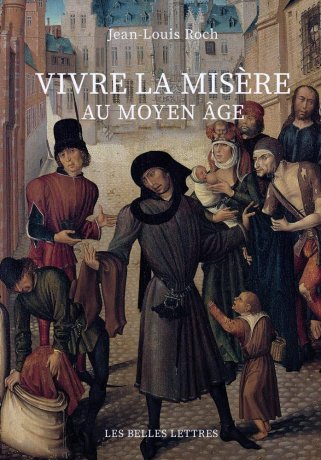
Drawing on textual sources and the history of language, Jean-Louis Roch highlights the ambivalence of charity in the Middle Ages and traces the desacralization of the figure of the poor at the dawn of modernity.
The Language of Exclusion in Medieval Europe
About: Jean-Louis Roch, Vivre la misère au Moyen Âge, Les Belles Lettres
About: Jean-Louis Roch, Vivre la misère au Moyen Âge, Les Belles Lettres

|
The subject of poverty and exclusion in medieval and modern Europe has been attracting growing interest among historians, especially since the success of Giacomo Todeschini’s book Visibilmente crudeli (2007). Jean-Louis Roch’s latest work, Vivre la misère au Moyen Âge (Experiencing poverty in the Middle Ages), but also Laurence Fontaine’s more recent Vivre Pauvre (Living in poverty), are examples of this trend. Long the preserve of major scholars such as Michel Mollat (The Poor in the Middle Ages, 1986) and Bronislaw Geremek (The Margins of Society in Late Medieval Paris, 1987), the subject has recently been revisited in studies that focus on the experience of poverty and the social category of the poor and, more specifically, on the modes of exclusion and othering that prevailed from the late Middle Ages onwards, in an increasingly dense urban world shaped by legal and political structures.
Vivre la misère au Moyen Âge is a welcome contribution to this historiographical renewal. Roch follows in the footsteps of Mollat, his doctoral thesis supervisor in 1986, and those of Geremek, with whom he shares the same thematic framework and the same interest in the semantic approach. Accordingly, he reconstructs the language of poverty and destitution of the late Middle Ages, exploring social dynamics through their representation and tracing a veritable genealogy of the figure of the outcast based on this very language.
The Usefulness of the Poor in the Economy of Salvation
To set the historical context for his study, Roch privileges an approach based on textual sources, paying particular attention to the experience of poverty. He conceives this experience not only as the lived reality of the poor, but as society’s perception of it. Indeed, with the rise of cities and the emergence of urban inequalities in the twelfth and thirteenth centuries, everyone had to get used to the presence of a new population of undesirable yet necessary paupers. Roch shows how, beyond providing a source of cheap labor, the phenomenon of poverty was integrated into a social order dominated by Christian doctrine. In this order, not only did the poor serve as a boundary marker for civilized society and as a foil for its members, but their existence was linked both to the person of Christ and to the Christian economy of soul salvation.
Poverty was indeed the site where both the salvation of the poor and that of the rich were played out. Despite predominantly negative representations, the presence of poverty was necessary in a social environment where charity was the condition of salvation for the rich. As part of this social equilibrium, the poor had to accept their situation and to reject any notion of social mobility, equality, or redress for the injustices of fate. Placed at the bottom of the social hierarchy, they saw their salvation in suffering itself and in the ability to endure the trials of existence. Roch sums it up as follows: “Poverty was a means of salvation for the poor” only “on condition that it was endured patiently” (p. 171). This logic was reflected in literary sources, but also in the writings of theologians who, like Thomas Aquinas, quoted Basil the Great’s Homily on Avarice: “Why are you rich while another is poor, unless it be that you may have the merit of a good dispensation, and he the reward of patience?” [1] (p. 174).
Fear and Rejection of Mobility
In the late Middle Ages, and particularly after the Great Plague of 1348, urban societies’ relationship to poverty began to change as a result of the rapid increase in the number of superfluous paupers (unemployed people and beggars) who could not be absorbed into the restricted labor market. A distinction emerged between the good and bad poor and between real and fake beggars (able-bodied beggars, vagrants, and idlers). This was accompanied by new regulations aimed at preventing vagrancy and at controlling the poor and forcing them to work. The modern policing of poverty, along with the practice of disqualifying the poor from receiving social assistance, can be traced back to this shift.
Despite this desacralization of the figure of the poor, the rejection of social mobility remained strong. According to Roch, this rejection entailed “the eradication of the desire for social advancement” (p. 71), which ran counter to the society of orders that was in the process of renewing and strengthening itself. It was reflected in the condemnation of geographical mobility and the importance given to the vagrant—a figure widely seen as dangerous and contemptible, as Geremek has shown in Truands et misérables (1980)—but also in the criticism of “people working in too many occupations” (p. 35) and the literary habit of mocking socially mobile figures like the schoolboy or the soldier (pp. 46-47). Until the sixteenth century and Rabelais, the idea persisted that all people should remain in their place. Theatrical literature provided several archetypes to support this idea. Chief among them was the topos of the happy poor, which functioned as a veritable “antidote to egalitarian demands” (p. 50).
Mocking the Poor: The Functions of Laughter
In privileging theatrical literature (namely farces and soties), Roch follows even more closely in Geremek’s footsteps, drawing particularly on his exploration of the “literature of roguery” in Les Fils de Caïn (1980). In late medieval and early modern cities, laughter took on an almost ritualistic function, like other forms of symbolic or physical violence directed at the poor. Produced at the expense of beggars in the “theater of the excluded,” [2] and also probably in ordinary practices of charity, it was used to correct the poor who lacked patience, were ungrateful, or behaved immorally. At the same time, it helped to create a distance or “disidentification” that reinforced the logic of pity and charity: “In addition to stigmatizing immorality, it played a thwarting role” (p. 182). Mockery stemmed not only from ignorance or misunderstanding of the figure of the poor, but also from a desire to distance oneself from it. This was but one aspect of the ambivalence of charity as a daily and obligatory practice.
Satirical literature is used in the book as a way to identify a popular discourse about poverty. Roch warns against the risk of studying poverty solely from the perspective of the elites—a trap identified earlier by Todeschini, who once wrote that “anyone writing about the medieval poor can only tell the history of their exclusion, devaluation, and infamy” (p. 200). Roch nevertheless considers it possible to approach the specificities of medieval poverty from below: the recurrence of famines and plagues; the intertwining of begging, war, vagrancy, and crime on the margins of society; the importance of hospitality and mutual aid; and finally, the absence of a state, with the Church playing a dominant role in shaping discourse and leading charitable institutions.
As Roch makes clear, the experience of poverty also entailed living alongside it, experiencing it as an omnipresent and threatening prospect. The ambivalence of charitable feelings—an ambivalence that persists in modern social assistance systems whose function is in part to exclude the undeserving poor—is rooted in this experience. Although this falls outside the scope of Roch’s study, it is worth noting that until the thirteenth century, canonists and theologians involved in scholastic debates paid considerable attention to the question of the rights of the poor, before gradually losing interest in it in the fourteenth century. [3]
The Fate of the Poor from Misfortune to Responsibility
Insofar as the book is a collection of some of Roch’s published works, it is not entirely free of the drawbacks inherent to this type of publication (some repetition and a certain formal heterogeneity). Nevertheless, the emphasis it places on the language of poverty perfectly reveals the simultaneity between the emergence of new social dynamics and the invention of new terms. The nascent French language included several terms referring to the poor, many of which gradually took on a pejorative (and sometimes very different) meaning in the modern era. Thus, “truand” initially referred to a beggar, without any connotation of deception (p. 116); “ribaud” was used to describe the lowest-ranked soldiers, before being associated with debauchery (p. 120); “coquin” meant kitchen boy, not rascal as it does today (p. 123); “bélître” strictly referred to a false beggar (p. 125); “trucheur“ designated a beggar and only later came to evoke the idea of cunning or trickery (p. 151); “cayman,” from which the modern term “quémander” (to beg) is derived, was associated with the figure of Cain, the Christian figure of the traitor (along with Judas) and “the father of the wandering races” (p. 133). Many others could be added to this list: “gueux,” “coquillart,” “harlot,” “gredin,” “maraud,” “bribeur,” etc.
Among these, the term “méchant” (wicked) deserves special attention (pp. 94-101). At first, a “meschant” was someone who had fallen into “meschance" (mischance or misfortune); by extension, the term also referred to the poor. In the fourteenth century, however, “meschant” no longer designated a person in need, but one that was prone to evil. According to Roch, this shift reflected a double transformation in the conception of the poor—one that resulted in the idea that those who suffered evil were also those who committed it, and even that they suffered evil precisely because they committed it. The first stage of this evolution was the introduction of human responsibility, and with it the notion that the poor were to blame for their poverty. The second was the discursive association of social lowliness with moral lowliness. Abandoning the old idea of the wheel of Fortune (p. 102), the communities of early modernity saw no more fortune in the “fortuné” (the rich) than misfortune in the “meschant”: The wicked’s “meschante vie” (miserable life) was no longer an accident, but a freely chosen lifestyle (p. 105).
All in all, the book goes beyond the medieval conception of poverty by highlighting the persistent tension between charity and rejection of the poor. It describes the largely theatricalized, medieval othering of the poor (via mockery, laughter, and the very act of charity), and shows how this othering was perpetuated—up to the present day?—in the modern policing of poverty through practices of “exclusion, forced labor, and eventually confinement” (p. 186).
Jean-Louis Roch, Vivre la misère au Moyen Âge, Paris, Les Belles Lettres, 2023, 260 p., 25, 50 €.
by , 25 September 2025
Share this article
Find us here :


To quote this article :
Julien Le Mauff, « The Language of Exclusion in Medieval Europe », Books and Ideas , 25 September 2025. ISSN : 2105-3030. URL : https://laviedesidees.fr/The-Language-of-Exclusion-in-Medieval-Europe
Nota Bene:
If you want to discuss this essay further, you can send a proposal to the editorial team (redaction at laviedesidees.fr). We will get back to you as soon as possible.
You might also like


Footnotes
[1] In this passage from the Summa Theologica (IIa IIae q. 32 a. 5), dispensatio is often translated as “stewardship”—a somewhat outdated translation that is similar to the French term “gestion” used by Roch. However, the original word and the context refer directly to the idea of distribution.
[2] See Jelle Koopmans, Le Théâtre des exclus au Moyen Âge: hérétiques, sorcières et marginaux, Paris, Imago, 1997.
[3] The most important study on the subject is Gilles Couvreur’s Les Pauvres ont-ils des droits ? Recherches sur le vol en cas d’extrême nécessité depuis la Concordia de Gratien (1140) jusqu’à Guillaume d’Auxerre, Rome, Editrice Università Gregoriana, 1961.
Our partners


Sections
Keep in touch
© laviedesidees.fr - Any replication forbidden without the explicit consent of the editors. - Mentions légales - webdesign : Abel Poucet