


Is Foucault’s genealogy concerned with the will to truth or with truth itself? According to Pascal Engel, in maintaining the ambiguity between the two, Foucault ignored the norms of knowledge as an essential source of emancipation.
Does Truth Have a History?
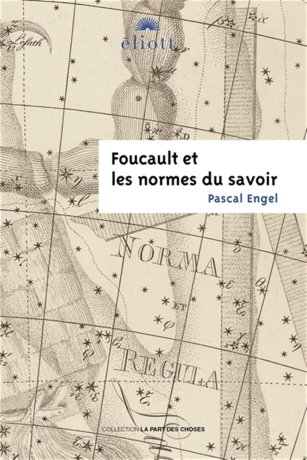
About: Pascal Engel, Foucault et les normes du savoir, Eliott éditions
About: Pascal Engel, Foucault et les normes du savoir, Eliott éditions

|
In his latest book, Foucault et les normes du savoir (Foucault and the norms of knowledge), Pascal Engel offers a critique of Foucault’s conception of truth and of its uses by some of his successors. [1] In doing so, he follows in the footsteps of Jacques Bouveresse, [2] who, in Nietzsche contre Foucault (2016), sought to demonstrate that Foucault was less consistent than Nietzsche in his approach to the notion of truth and therefore less respectful of it. [3] The criticisms formulated by Bouveresse were precisely those that led Engel to distance himself from Foucault, after having long been his fervent disciple. [4] Thus, although this goal is not explicitly stated, Foucault et les normes du savoir can be read both as a retrospective look at Engel’s own philosophical journey and as a testimony to how that journey was shaped by his conception of the proper relationship to truth. While Engels’ critiques are sharp, his tone is measured and free of acrimony, opening up space for dispassionate discussions.
The book is not an exegesis of Foucault’s work, nor is it is a monograph aimed at tracing the structure or genesis of that work. Rather, it is a critical examination of Foucault’s identifiable theses regarding the notion of truth. According to Engel, these theses are inseparable from the Foucauldian critique of norms, insofar as, for Foucault, the study of normativity is a necessary condition for individual emancipation. To illuminate the debate on the relationship between freedom and the critique of norms, Engel highlights the ubiquity of norms in contemporary philosophy (p. 25) and then offers a conception of the fundamental normativity of thought. Against Foucault’s confusing approach to the notion of truth, he proposes this theory of the norms of knowledge as the basis for an alternative conception of emancipation in which the relationship to knowledge is given pride of place. This conception, however, does not imply that Foucault’s work must be considered null and void, but that its philosophical significance must be clarified and reassessed, at least for some of its major propositions.
Truth or the Will to Truth?
According to Engel, Foucault is, at best, ambiguous regarding the question of whether the object of his inquiry is truth itself or the will to truth. Yet, while it is possible to write a history of the will to truth, can the same be done for truth itself? Furthermore, can one critique the will to truth in the name of a criterion or norm that is completely unrelated to truth? That is, can one critique the will to truth without critiquing truth itself? In fact, writes Engel, Foucault only manages to formulate a “radical contextualism” (p. 79) that seems to imply a purely conventionalist—and therefore untenable—conception of truth. Impossible on the epistemic level, Foucault’s position is just as difficult on the ethical level: It constantly shifts “from the will to truth to the truth of will” (p. 80). In other words, in his investigations, Foucault never speaks of truth, only of the will to truth, as if one could, in doing so, disregard truth itself.
For Engel, however, truth cannot be so easily forgotten. He therefore proposes, based on Bernard Williams’s Truth and Truthfulness, a comprehensive alternative to the Foucauldian genealogy of true discourses. For Engel reading Williams, telling the truth is formally an assertion, namely a speech act in which the agent necessarily believes that what he says is true. Yet, in practice, we cannot do without assertions, that is, without the necessary entanglement of belief and truth. Consequently, the attitudes toward truth that Foucault describes have nothing to do with assertions, but only with what might be called “virtues of truth” (pp. 95–96)—among them the intention to speak the truth (sincerity) and the personalization of the relationship to truth (authenticity).
In short, for Engel, Foucault’s work must be understood not as a history of truth, but as a history of the virtues of truth—a perspective that clearly undermines the Foucauldian project (i.e., writing a history of “the divisions between true and false”). Moreover, there remains the question—unaddressed by Foucault—of the ethical value of believing in the truth as truth.
The Norms of Truth Itself
According to Engel, the story told by Foucault is the story of the forgetting of the spiritual dimension of our relationship to truth: Philosophical modernity, beginning with Descartes and Locke, ushered in an era in which truth no longer had any practical implications for the subject. As Foucault notes in The Hermeneutics of the Subject, truth now reveals itself only in a purely objective manner, and the history of subjective relationships to truth prior to the modern rupture is precisely what allows us to assert the spiritual dimension of truth today. Engel challenges this thesis, which he sees as another version of Weber’s theme of the disenchantment of the world. He does so in the name of an absolute and ahistorical value of the norm of truth.
To make his case, Engel develops what he calls another genealogy of the virtues of truth—namely, a history of the values that have been ascribed to truth. This history is not critical but, on the contrary, laudatory: It is a “positive genealogy.” Concretely, Engel’s genealogy consists in a reinterpretation of the history of modern philosophy, from Locke and Kant to contemporary pragmatism through Neo-Kantianism. For Engel, the question of the relationship between cognitive norms—which guide the will to know—and ethical norms has taken “the form of a reflection on the constitutive norms of thought” (p. 142). Such a genealogy stands in sharp contrast to Foucault’s grand narratives wherein the history of philosophy is embedded in the history of ideas and practices.
This move allows Engel to challenge the foundations of much social science research conducted based on Foucault’s hypotheses, which in his view conflates knowledge with its social or practical effects (pp. 147, 162). Engel holds Foucault primarily responsible for these conflations and describes him as the proponent of a veritable “anti-epistemology.” Contra Foucault and his followers, he argues that truth cannot be reduced to an effect of the will that would be either purely arbitrary or linked to a poorly elucidated social function (pp. 176–178).
The Ethical Dimension of Truth
Ultimately, for Engel, the irreducibility of truth to ethical attitudes toward it (that is, to the relationships one might have to truth) lies in the fact that truth itself has an ethical dimension and that this dimension is not dependent on historical context. Admittedly, Foucault did examine the ethical dimension of the relationship to truth in his later works, particularly in his analyses of the ancient concept of parrhêsia, which he defined as the courage to speak the truth. Engel nevertheless chides him for not bothering to define truth, that is, for failing to provide a criterion of truth that would validate the individual’s belief that he or she is speaking the truth—a criterion that would be external to that individual’s belief.
That this is a gap, and more profoundly, a flaw in Foucault’s thought is demonstrated by the fact that his late analyses leave us defenseless against practices—not of lying, but of sheer indifference to truth—with which we are inundated today, and which fall under the category of what Harry Frankfurt refers to as “bullshit.” It has now become obvious that indifference to truth produces massive effects of domination. Foucault’s mistake lies not only in failing to foresee the problem, but above all in refusing to use truth as a resource to combat such effects of power. This failure effectively prevents his readers from pursuing ways to achieve freedom.
Thus, the distinction Engel proposes between knowledge (or true belief) and the will to knowledge leads to a devaluation of Foucault’s work, which appears to concern the history of beliefs rather than the history of knowledge itself. Paradoxically, in limiting himself to the preservation of the ahistorical invariants of truth norms, Engel leaves untouched the domain of the history of our relationships to truth—the very domain Foucault explored through a history of the relationships between knowledge and power. For Engel, these relationships cannot be viewed as the history of knowledge itself. However, and as he himself notes, Foucault conceded that point in some of his texts: If there is a relationship between power and knowledge, it is because the two are distinct and because they obey different norms. Engel preserves the norms of knowledge and shows that they are ignored at our peril. But is it not possible to assess the relationships between knowledge and power entirely on the basis of the norms of knowledge?
To this Engel might respond that Foucault, insofar as he remained trapped in a position of complete contextualism and relativism, did not to conduct this assessment either. Yet, just as Engel made room for the ethical dimension of epistemic norms, Foucault’s work could be supplemented with a political study of the history of power relations. Foucault was not only an anti-epistemologist, but also an anti-anthropologist, in the sense that for him knowledge about man could not justify social relations since these were nothing but power relations. The fact remains that Engel’s project, critical as it is, also leaves room for a philosophy—or anthropology—of the historical forms of justice. With the exception of works directly inspired by Foucault, sociology and anthropology are, paradoxically, conspicuously absent from this book on norms. One might therefore undertake other “positive genealogies” of values—as some have, in fact, already done. [5]
Pascal Engel, Foucault et les normes du savoir, Montreuil, Eliott éditions, collection « La part des choses », 2024, 284 p., 21 €.
by , 5 May
Share this article
Find us here :


To quote this article :
Thomas Boccon-Gibod, « Does Truth Have a History? », Books and Ideas , 5 May 2026. ISSN : 2105-3030. URL : https://laviedesidees.fr/Does-Truth-Have-a-History
Nota Bene:
If you want to discuss this essay further, you can send a proposal to the editorial team (redaction at laviedesidees.fr). We will get back to you as soon as possible.
You might also like


Footnotes
[1] I would like to thank Rémi Clot-Goudard for his comments on an earlier version of this text (inaccuracies and errors are entirely my own).
[2] It is to be noted that Engel dedicates his book to Bouveresse.
[3] Jacques Bouveresse, Nietzsche contre Foucault, Paris, Agone, 2016.
[4] Pascal Engel, Foucault et les normes du savoir, Montreuil, Eliott Editions, 2024, p. 43; see also Pascal Engel, “Michel Foucault, vérité, connaissance et éthique,” in Philippe Artières, Jean-François Bert, Frédéric Gros, and Judith Revel (eds), Cahier de L’Herne 95: Michel Foucault, Paris, L’Herne, 2011, pp. 318-325.
[5] Robert Damien, Éloge de l’autorité: Généalogie d’une (dé)raison politique, Paris, Armand Colin, 2013; Hans Joas, Comment la personne est devenue sacrée: Une nouvelle généalogie des droits de l’homme, translated by Jean-Marc Tétaz, Genève, Labor et Fides, 2016.
Our partners


Sections
Keep in touch
© laviedesidees.fr - Any replication forbidden without the explicit consent of the editors. - Mentions légales - webdesign : Abel Poucet