

Long the subject of myth, Pius XII’s attitude towards the Holocaust and Jewish persecution can now be evaluated with the help of the archives. Nina Valbousquet makes a convincing case: the issue was not impartiality, but tepidness.
A pope’s silence
About: Nina Valbousquet, Les âmes tièdes. Le Vatican face à la Shoah, La Découverte
About: Nina Valbousquet, Les âmes tièdes. Le Vatican face à la Shoah, La Découverte

|
Nina Valbousquet’s fascinating book consists of a series of master strokes, due to her command of the historiography, methodology, style, and erudition. It is a complete, and perhaps total work of history. She shows her colors beginning with the title itself, which she borrows from Albert Camus, specifically an article for Combat in which he commented on Pope Pius XII’s Christmas 1944 radio address. While the pope ultimately declared his support for the Allies and democracy against Nazism, his words were a far cry from the “clarity” demanded by Camus (a word he uses four times in a few lines). The engaged writer concluded: “Our world does not need tepid souls. It needs burning hearts.” [1] For Camus, “evil” was real—as seen in the “ventures of dictatorships”—and he continued to believe, despite this new disappointment, that the pope should speak out against it.
Archives without fetichism
Valbousquet’s entire book is an attempt to show who these “tepid souls” are when they confront “evil”—not just the pope, but his entire entourage, a complex hierarchy whose mechanisms Valbousquet understands perfectly. The book owes much of its quality to the fact that its author was among the first scholars to gain access to Pius XII’s archives , which Pope Francis opened in 2020. Finding one’s way around the Vatican archives, particularly series that have just been opened, is incredibly complicated, as this author knows: in 1985, she was given a similar opportunity and challenge following the opening of Pope Benedict XV’s archives (relating to the First World War and the pope’s humanitarian policies). Valbousquet avoids the obvious mistakes: to plow through the archives in search of scoops without mastering the historiography or grasping the connections between documents produced by the different offices of the papal state—which is tiny, but with gigantic global ramifications and correspondingly labyrinthine archive, a very hierarchical spiritual power that in many ways is also very divided. She arrived at Pius XII’s archives, equipped with enormous historiographical and methodological knowledge, without the least “archive fetichism,” convinced that the time had come to plunge into the documents in their current state, with all their deletions and uncertainties, and persuaded that it was time to turn the page on the at times incriminating, at times exonerating digests that have proliferated since the 1960s, building on the initial questions that arose during the war itself. Her focus is the archives, and nothing but the archives—yet she does not overlook polemics launched in the 1950s and 60s by literary works and film, such as Rolf Hochhuth’s 1963 play The Deputy or Romain Gary’s 1967 novel The Dance of Genghis Cohn, in which a German genocide perpetrator haunted by a ghost—a dibbuk in the Jewish tradition—observes: “If Pope Pius XII had said something, we would have had less of an alibi to kill the Jews … All we wanted was an alibi so we would not have to kill them.”
“Impartiality” or deliberate silence?
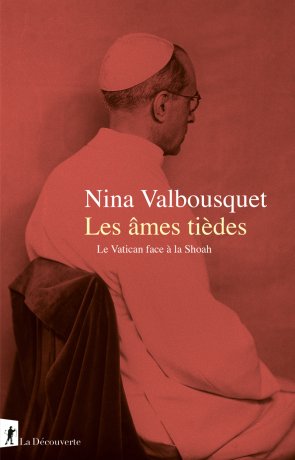
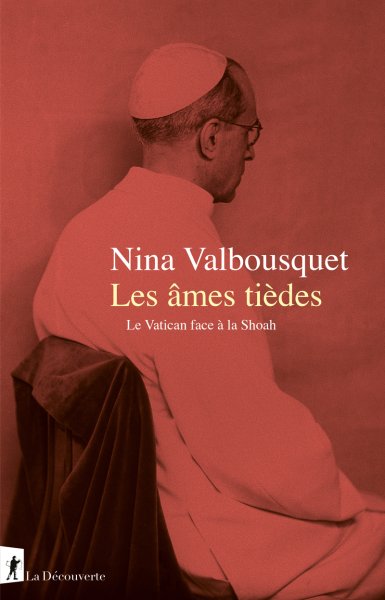
The book’s subtitle is very important, as it makes clear that it is concerned not with how the Vatican confronted Nazism or dictatorship, but how it confronted the Holocaust. Its question is more limited than the vast issues raised by the Second World War, and more consistent with the interrogations that first arose in the 1960s, when the extermination of Europe’s Jews became modern society’s “dark star”:—questions pertaining to the pope, his temporal and spiritual powers, the persecution and the genocide (a term coined by Raphael Lemkin in 1943-1944) of the Jews, from the massacres in the East to the deportations to the extermination sites. The underlying question is: how is one to explain the “silences,” contradictions, and dubious conduct of the Vatican hierarchy, despite the information that had made it up through the ranks? The cover photograph, in which the pope is seen almost completely from behind, as if he were absorbed in a world in which he did not live with other mortals, is particularly well chosen.
Valbousquet builds on the work inaugurated by the mentor of this period’s historians, Giovanni Miccoli, who, in Les dilemmes et les silences de Pie XII. Vatican, Seconde Guerre mondiale et Holocaust (Dilemmas and silences of Pius XII. The Vatican, the Second World War, and the Holocaust, 2005, Complexe, 2000 in Italian), took cross-references, reflection, and a regressive method inspired by Marc Bloch further than anyone before. Valbousquet, who is fluent in the historiography, has opted for a form of microhistory, involving the study of specific dossiers, such as word choice in papal speeches, interventions in internment camps, and the Vatican’s limited interest in Jews who had converted to Catholicism. She knows all the ins and outs and sheds light on the new insights—or lack thereof—arising from the consultation of new archives. She achieved all this in a mere four years, from the opening of the archives to publication. Her book is a tour de force.
Valbousquet has organized the book into three parts: “Jews and ’Non-Aryan Catholics,’ 1938-1941,” “Help and Silence: The Vatican Confronts Genocide, 1941-1944,” and “After the Holocaust.” We have, in short, a before, during, and after the Holocaust, from the persecution of the Jews that began in 1933 to the beginning of their systematic extermination in the East in 1941, to the extension of the genocide throughout the West in 1942. She also examines the contemporary legacy of these events, from the moderate forgetting by more open individuals to the resurgence of Holocaust memory, during which the Vatican followed the general trend, down to the Vatican’s refusal to see the persistence of antisemitism in postwar Poland, as during the Kielce pogrom.
Following her exemplary method, Valbousquet concludes: yes, the pope’s silence on the Holocaust, about which he was well informed by 1941, was deafening, deliberate, and decisive. It did not prevent rescue efforts—including successful ones. But to what end? How different is the idea of impartialità (papal neutrality) from the “tepidness” of the International Committee of the Red Cross? After all, the former believed that the slightest denunciation of the Nazis would expose German and European Catholics to retaliation, while the latter worried about the fate of prisoners of war, who were its primary responsibility. Throughout the period from 1939-1945, the Vatican’s line did not change: better to display no hostility to the Nazis, lest something worse happen. But what could be worse than, for instance, the two “Jewish statutes” and Vichy’s policy towards the Jews in France? After the war, a myth was devised by Catholics and particularly Catholic historians to defend the pope: Pius XII was certain that German and European Catholics would find themselves in incredible danger if he intervened on the Jews’ behalf. This position was still being taught in universities in the 1980s. Yet the entire first part of Valbousquet’s book demonstrates the persistence, in the Vatican, of the remnants of ancient anti-Judaism and Christian anti-Semitism, as evidenced by nuncios and bishops who had no qualms about borrowing the argument (from Vichy, for instance) that the Jews were “warmongers.” As the American historian Marion Kaplan (whom Valbousquet cites) [2] has shown, acceptance of the persecution of Jewish rights (such as legal persecution, marking with Stars of David, and so on) could quickly become persecution of Jewish lives. Valbousquet shows with great subtlety that while rescues did occur when they were still possible—particularly through emigration assistance—they sought to save souls, not persecuted human beings. Indeed, only converted Jews or—to use a very revealing term—“non-Aryan Catholics” (i.e., converts) were eligible for the Vatican’s “beneficence.” The emphasis on the Brazilian network’s successes and failures is an effective way of showing that even before the genocide, silences were greater than dilemmas, and that dilemmas vanished when Jews were no longer Jews, but Catholics.
Valbousquet also allows us to hear the voice of the Jews found in the archives, giving them back agency that many studies of the Holocaust, and particularly of churches and the Holocaust, tend to neglect. She might have paid a bit more attention to the fact that Churchill and Roosevelt were, like Pius XII, informed early on that the Jews were being specifically exterminated and that none of them took full stock of the catastrophe that was underway at the same time as the war. They all thought, like Pius XII, that the extermination of the Jews was just a detail because it suited their policies. It also suited the pope’s faith: even when Rome’s Jews were rounded up in 1943, he was still more wary of them than of their executioners.
This book, which is remarkable as much in its form as its content, must be accompanied by the catalog of the Paris Holocaust Memorial exhibit, “’By the grace of God’: The Churches and The Holocaust,” for which Valbousquet was a curator. The exhibit displays original archives and presents her new research to the public. She also edited an issue of the Revue d’histoire de la Holocaust, “Le Vatican, l’Église catholique et la Holocaust” (The Vatican, The Catholic Church, and the Holocaust, October 2023), which allows one to dive deeper into various topics thanks to a wonderful team of scholars.
The time needed for in-depth work on the archives is unlikely to call Valbousquet’s interpretive framework into question. It is, moreover, accepted by the current pope, who has done everything in his power to understand his predecessor (and predecessors), who reacted so differently than him to the horrors of which humans showed themselves capable. Yet so many other genocides and so much extreme violence still leaves “tepid souls” unmoved, even when, at minimum, they have the power to say “no.”
Nina Valbousquet, Les âmes tièdes. Le Vatican face à la Shoah (Tepid souls: The Vatican confronts the Holocaust), Paris, La Découverte, 2024, 480 p., 26 €
by , 16 December 2025
Share this article
Find us here :


To quote this article :
Annette Becker, « A pope’s silence », Books and Ideas , 16 December 2025. ISSN : 2105-3030. URL : https://laviedesidees.fr/A-pope-s-silence
Nota Bene:
If you want to discuss this essay further, you can send a proposal to the editorial team (redaction at laviedesidees.fr). We will get back to you as soon as possible.
You might also like


Footnotes
[1] [Translator’s note] Albert Camus, Between Hell and Reason: Essays from the Resistance Newspaper Combat, 1944-1947, Alexandre de Gramont trans. (Hanover, NH: Wesleyan University Press, 1991), 99.
[2] Marion Kaplan, Hitler’s Jewish Refugees. Hope and Anxiety in Portugal, New Haven, Yale University Press, 2020.
Our partners


Sections
Keep in touch
© laviedesidees.fr - Any replication forbidden without the explicit consent of the editors. - Mentions légales - webdesign : Abel Poucet