

We would rather not see or even think about our waste, but it has a lot to tell us about our habits, our lives, and more importantly, about what we are doing to our world today.
A World of Waste
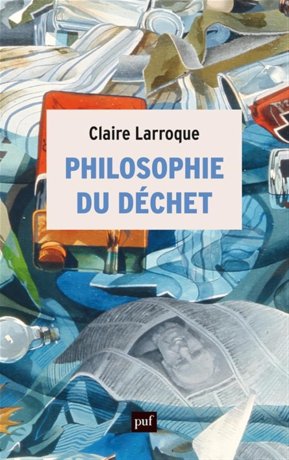
About: Claire Larroque, Philosophie du déchet, Presses universitaires de France
About: Claire Larroque, Philosophie du déchet, Presses universitaires de France

|
If there is such a thing as a life of ideas, paradoxically it is most immediately apparent in the world of waste, refuse, rubbish, and filth. For it is on these that our materials and our ways of making the world depend. And so, in a rather idealistic tradition, some might think that there is nothing to say about waste, and certainly not enough to make a philosophy out of it. Others, without being materialistic, but at least materially minded, will argue that it is important to rematerialize and weigh our experiences of the trials of the world, and that to this end, waste, detritus, and the abject offer opportunities to think, to live, and even to philosophize. Claire Larroque’s book Philosophie du déchet (Philosophy of Waste) is, in part, written in this vein. She approaches the subject from the ecological perspective of a philosophy of living environments, since the “Trash Age” could well serve as an alternative name for the Anthropocene. Indeed, have our waste products not become “object-worlds,” with the trash we discard here potentially impacting places thousands of miles away? Not only is our waste traded globally, but it has grown to the size of a sixth continent, with our plastics accumulating in the middle of the ocean. Given that waste is a troubling reflection of human impact and a stark testament to the disconnect between humans and their environment, surely, we should urgently start thinking about waste? We continue to view the environment either as a quarry from which to extract materials, as a landscape from which to derive pleasure, or as a dump — often converted out of the other two. Rarely is it treated as a partner. It has therefore become vital to ask ourselves not only where our waste goes in our technological civilization, or what to do about it, but also what to do with it, thinking and living our existence under the banner of finitude. These are the questions that the philosopher seeks to address in her book.
Waste: a matter worth considering?
Indeed, this is a vital undertaking. While the verbs “throw away” and “discard” may seem to retain a semblance of similarity between Socrates’ time and our own, radioactive waste is not thrown away like an amphora; toxic or electronic waste is not discarded like an old chariot wheel left on a rubbish heap. While Socratic sayings may have successfully echoed and reverberated across millennia in the curious and anxious memory of humans, it is now our waste that punctuates our existence over the long term. It binds present and future generations more immediately than any inspired words ever could. No doubt we are all a little Platonic, in that, even more than matter itself, long considered unstable for thought, detrital matter seems to us to tend towards the formless, with the corruption of form becoming the very opposite of thought. In Parmenides, did Plato not say that by attempting to think about “hair, mud, dirt, or anything else particularly vile and worthless,” we risk sinking into an “abyss of nonsense” (Parmenides 130c.)? Waste seems to lead less to reflection than to a breakdown in thinking, confronting us with the unthinkable nature of what dissolves into formlessness. But in a sudden burst of attention to the earthly, we can reject this slippery slope which, between form and formlessness, sets waste on the path to decay. In line with Canguilhem, we can, on the contrary, attest that in philosophy there are no foreign subject matters. That any matter is good matter for thought. This is what François Dagognet, in the spirit of Canguilhem, sought to do, transforming himself less into a materialist than into a “materiologist,” curious about the abundant diversity of the worlds of detritus, waste, and the abject. The endeavor Larroque undertakes here — to construct a philosophy of waste — acknowledges this legacy and favors “taking the side of things,” in the words of poet Francis Ponge. To this end, she works to defuse the language of misleading metaphors and pluralize the language of garbage. She dismantles the symbolism of the fall, which places waste in the category of that which falls, collapses and dissolves into formlessness, instead offering other symbols in its place. One is the symbol of circularity in recycling and upcycling processes. Another is the symbol of connection, in the awareness of belonging, in the organic model that makes waste part of a process linked to the reproduction of life, from which it cannot be separated (p. 357). Waste is also a common good, finding its paradigm in the composting of organic matter (from domestic worm composting to the urban reterritorialization of kitchen waste). The book sets out to slow down the descent of waste into decay, turning it into an opportunity to revisit our connections.
The social construction of discards
Philosophers are not the first to take an interest in waste, in its dual symbolic dimension (the cultural imagery of contamination and stains, which Paul Ricœur identified as symbolic of defilement) and material dimension (from organic waste to the proliferation of industrial waste and ultimate residues). It is important to recognize the role played by the social sciences (anthropology, ethnology, history, sociology) in seeing waste not as something inhuman, but as something very human. In Marcel Mauss’ famous words, [1] “The most important thing to study in a society is its garbage dumps.” He expanded on this idea, adding: “We must not be afraid to collect even the most humble and despised objects. [...] By rummaging through a pile of garbage, we can reconstruct the entire life of a society.” Through the social sciences — the book does not examine in depth the contributions of psychoanalysis to the relationship between emotions and the morbid impulses involved in our relationships with broken, chipped, moldy, and rotten things — we can engage in philosophical inquiry. It is thus possible to construct a symbolic philosophy, highlighting that the imaginary of defilement reveals “a social construction of disgust” (p. 94) which can, therefore, be discussed, worked on, and reoriented. Furthermore, it is a question of reintroducing it into a philosophy of technology that questions the waste treatment industry, its engineering, and the economics of the informal or formal waste market via the great sorting machine.
The philosophy of science and technology allows us to extract our waste from the shapeless, indistinct, and confusing mass in which the word “discards” confines it. It invites us to move away from the management approach that views waste from the outset as the end of a cycle, always ending with the final waste to be disposed of. It paves the way for a culture that is more concerned with maintenance, upkeep, and repair, with a daily focus on “taking care of things,” as sociologists of technology David Pontille and Jérôme Denis would say. Changing our attitude towards waste means acknowledging that breakdown is specific to the world of artifacts rather than signaling failure, as suggested by the abstract technicist ideology of smoothness that extols the virtues of the new and consumable while rejecting discards. It is a matter of rediscovering them as deeply human rather than inhuman. It is indeed the extractivist and productivist culture, champion of the irreparable and the disposable, that must be challenged:
“By reconnecting with technical objects by paying close attention to their specific functions, [...] we are challenging our systematic discarding behavior, driven by a consumerist production system that manufactures standardized, decontextualized objects whose labels (‘disposable’, ‘single-use’, etc.) generate individualistic, mobile behavioral norms that pay little attention to the environment and are quick to reject and abandon items” (p. 407).
For Claire Larroque, however, this philosophy of technology must also extend to an ethics and policy of waste, given that waste is at the heart of issues of environmental and social injustice. The choice of waste recovery techniques raises ethical and political issues, meaning that it cannot be considered solely as a technical matter. How are we collectively being deprived of control by waste management systems in these times of ecological transition? Talking about waste in terms of management is to depoliticize it by pretending to administer it. Management means depoliticization, impoverishing local sorting practices and know-how; it means making the global trajectories of waste invisible and erasing environmental and social injustices by shifting them elsewhere. Who lives alongside our garbage? Simply asking ourselves collectively where our waste goes — something we are mostly unaware of — is enough to discover that the globalized issue of waste involves relationships of domination and neo-colonization. The richest populations and countries are, quite literally, offloading their responsibilities with regard to plastic, electronic, toxic, and radioactive waste onto the poorest countries. Larroque’s book presents some very interesting, painful, and decisive findings concerning more or less legal open dumps, mafia-run toxic waste sites, and decisions to build incineration plants, revealing conflicts of use and political choices, whether in Abidjan, Los Angeles, or Naples.
Finally, we must go as far as to consider an ontology that contemplates the question of nothing, of nothingness, in the same way that we go to the very core of a civilization through its conception of non-being. With regard to waste, in the death of the object, there is an opportunity to develop a meditation on futility and death. Disgust towards waste could be a form of disgust towards our own finitude (the corpse that is no longer quite a person, but is not yet a thing, raises the question: is it waste like any other?). How do we conceive of our own demise, and of finitude more generally? Waste answers this question with an object lesson! The illusion of believing we can become infinite or escape the world — the illusion of believing in infinite growth in a finite world, or of denying the inevitability of death — is dispelled by the ontological test of waste. It imprints our lives with the mark of belonging to what is finite and will come to an end. This is not the name of a failure, but of a situation. In this sense, waste is not filthy, concludes Claire Larroque. It is not “to be rejected from the human world because it threatens the intrasocial symbolic order”; “the filthy becomes something that destroys […] the multitude of living forms […] and annihilates all forms of relationship with nature” (p. 427). Waste is not necessarily disgusting; it can also represent what is, and what gives life to the living.
The great divide in modern naturalism unfolded around waste, which, in order to exist, separated, excluded and distanced nature and artifice, form and formlessness. Its culture of order and form rejected contagion by formlessness as a force of disorder. Another way of thinking, other practices, in and through the awareness of connections, suggests that waste is less a form of decay than a consciousness, albeit a disturbing one because it is not glorious, of our dependencies and our affiliations. This opens up a possible horizon for considering non-morbid waste practices that are mindful of the living world. What if waste became the likely name for our earthly anchors? Thinking of waste in terms of connection rather than nothingness may do us good.
Claire Larroque, Philosophie du déchet, Paris, Presses universitaires de France, 2024, 440 pp., €24, ISBN 9782130858034.
by , 31 March
Share this article
Find us here :


To quote this article :
Jean-Philippe Pierron, « A World of Waste », Books and Ideas , 31 March 2026. ISSN : 2105-3030. URL : https://laviedesidees.fr/A-World-of-Waste
Nota Bene:
If you want to discuss this essay further, you can send a proposal to the editorial team (redaction at laviedesidees.fr). We will get back to you as soon as possible.
You might also like


Footnotes
[1] Words of Mauss transcribed by Michel Leiris in Instructions sommaires pour les collecteurs d’objets ethnographiques, MNHN, Mission scientifique Dakar-Djibouti, Paris, 1931, p. 9.
Our partners


Sections
Keep in touch
© laviedesidees.fr - Any replication forbidden without the explicit consent of the editors. - Mentions légales - webdesign : Abel Poucet