


In his academic reading of Julia Cagé and Thomas Piketty’s book, Michel Offerlé provides a critical analysis of the selected indicators, followed by a comparison with works of electoral sociology and electoral history.
Two Centuries of Alternation, 2
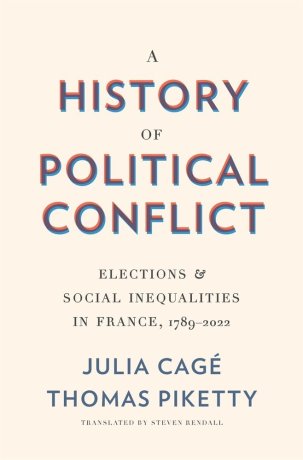
About: Julia Cagé & Thomas Piketty, A History of Political Conflict : Elections and Social Inequalities in France, 1789-2022, The Belknap Press of Harvard University Press
About: Julia Cagé & Thomas Piketty, A History of Political Conflict : Elections and Social Inequalities in France, 1789-2022, The Belknap Press of Harvard University Press

|
Below is the second part of Michel Offerlé’s review of Julia Cagé and Thomas Piketty’s A History of Political Conflict: Elections and Social Inequalities in France, 1789-2022. A political reading of the book is presented in the first part of this review.
In Search of “Geosocial Classes”
Julia Cagé and Thomas Piketty, along with the several dozen researchers who have joined them in their adventure, pursue an ambitious goal: To renew our knowledge of political conflict through a longue durée study of elections in which hypotheses are systematically tested against large amounts of archival and statistical data.
Here I will remain within the scope of the authors’ framework, trying to understand what they do, summarizing their results, and, when necessary, raising internal objections to their reasoning.
The analysis proceeds by correlating sociodemographic indicators with election results. To take one example among many (p. 454, Figure 10.5), the vote for the “Left bloc” in the 1981 elections is shown to have “diminishe[d] with the municipality’s average level of income” after and before (sociodemographic) controls: While this vote was above the national average in the lowest income decile, it was between 40 and 50 percent of the national average in the “richest” 1 percent of the municipalities.
The selected sociodemographic indicators are detailed in the three chapters that form the core of Part 1 (“Classes and Territories: Sociospatial Inequalities in France Since the Revolution”): Sociospatial inequalities are discussed in Chapter 2 (pp. 72-120), educational inequalities in Chapter 3 (pp. 121-159), and demographic diversity in Chapter 4 (pp. 160-205, which detail the origins and religious affiliation of different populations).
Who Are the Authors’ Interlocutors?
Since the methodological introduction presents the authors’ position without really discussing other possible approaches, the question arises as to who their allies, influences, and interlocutors are.
Cagé and Piketty build primarily on the framework developed by André Siegfried in Tableau politique de la France de l’Ouest, [1] which was continued by Gaston Génique and François Goguel and then revisited by Paul Bois. They nevertheless point out that Siegfried and his followers “unfortunately” focused on excessively large units (cantons and departments) and made too little use of sociodemographic indicators, thereby failing to illuminate voting patterns. To correct this shortcoming, they use massive amounts of municipal data and correlate votes in different elections with sociodemographic indicators. Their aim is to make historical comparisons and to understand the correlations between electoral results and key geosocial indicators over the longue durée. Central to their approach is the correlation of territorial variables (size and type of municipality) with social indicators. Among the latter, the sociodemographic characteristics of the municipality (origins, education, occupation, income, real estate capital, etc.) are far more central to the book’s discussion than the variables typically found in electoral sociology studies relying on individual surveys. While Cagé and Piketty pay some attention to the variable of age, especially in relation to voter registration and turnout, they almost completely ignore that of gender (except on p. 520 ff.). However, they do devote several pages (p. 169 ff. and p. 305 ff.) to another classic variable of electoral sociology: religion, in particular the proportion of children attending private schools and, for the Revolutionary period, the proportion of refractory priests.
The authors do not quarrel with other schools of electoral sociology. They cite them with respect, without seeking to validate or invalidate their findings.
This, for instance, is how they describe the dominant strand of electoral sociology:
These so-called post-electoral surveys (usually conducted in the days or weeks following the election studied) have given rise to exciting, innovative kinds of research, particularly in French political science since the 1950s, notably by Jacques Capdevielle, Nonna Mayer, Guy Michelat, and many other authors. (p. 10) [2]
With the caveat that:
The price to be paid for this methodological innovation is that it may have helped diminish interest in the method based on spatialized electoral data, and in that way, focused attention on the post-1950 period (when it does not focus on more recent periods) and reduced the import of research on the transformations of electorates over long periods. (pp. 17-18)
Similarly, the few ethnographic surveys cited are described as “uniquely rich”: Voter par temps de crise (edited by Éric Agrikoliansky et al., PUF, 2021) and Les sens du vote (Collectif SPEL, PUR, 2016) are presented as “fascinating examples of ethnographic surveys” (p. 11), and Kevin Geay’s method is deemed “irreplaceable” (p. 416).
Hervé Le Bras and Emmanuel Todd are cited as having produced “stimulating” studies (p. 17). On the other hand, the works of Patrick Lehingue, [3] who has spent several decades exploring quantitative approaches to voting (more on this later), are not discussed.
Jean Rivière, who has published excellent geosociological studies of elections and who has likewise examined the links between spatial inequalities and political behavior (L’illusion du vote bobo. Configurations électorales et structures sociales dans les grandes villes françaises, PUR, 2022), is cited a few times. However, Cagé and Piketty engage little with Rivière because his work focuses on a smaller scale than the municipality and because it lacks the historical depth that they are aiming for (see p. 12, Note 11).
Although commendable, this ecumenism makes it impossible to compare the book’s findings with those of earlier studies. It also obscures the originality of Cagé and Piketty’s argument—for instance with regard to the “patrimony effect,” which has been well documented since 1978.
Christophe Guilluy, whose France périphérique et le péri-urbain (Flammarion, 2014) has become prominent in the media political debate in France despite its many methodological weaknesses, is subjected—and rightly so—to a lengthy critique. By contrast, Jérôme Fourquet, another popular media figure, is quickly swept aside.
While the book mentions several—though not all—electoral historians and socio-historians, it fails to address their rich descriptions of what an election is. The famous passage from Tocqueville’s Souvenirs, in which the political philosopher discusses the elections of April 23, 1848 in his own constituency, is quoted on p. 52. Lastly, only one newspaper, Le spectateur de Dijon, is cited to provide empirical grist for the analysis (pp. 399-400).
How to Read “A History of Political Conflict”?
To enter the book, one must accept the definition of conflict that is implicitly provided. In this regard, the book’s title is problematic because the authors examine “political conflict” through the lens of elections alone—and even then, the focus is on electoral results, not electoral mobilizations.
One must also accept the five principles that underpin the methodology and analysis:
1. “To have any hope of understanding recent trends, it seems to us essential to begin by adopting a long-term view” (p. 211). “On this question, as on others, the central question is how to constitute an adequate empirical basis for making significant historical comparisons between periods” (p. 388, Note 88). Thus, while non-longitudinal studies may well be interesting, relevant, and even stimulating, they can only serve as a counterpoint to Cagé and Piketty’s own work, which purports to renew electoral geosociology using a “longue durée” approach (the term appears several times in the French version of the book).
2. “The pertinent concept of social class corresponds in reality to a geosocial (or sociospatial) class whose contours are constantly being redefined by economic processes, and especially by the ongoing political experiences and lessons that individual draws from events” (p. 23). As we have seen, this requires data that are compatible with approaches based on a spatialization of the social.
3. The ecological fallacy (as per William S. Robinson’s 1950 article [4]) can be overcome by using a more specific geographical level—namely, the municipality (pp. 275-276, Note 27).
4. To understand how the variables “act,” electoral results must be classified according to categories derived from the notion of “party system” (pp. 322-325), a term more common in American than in French political science. The categories “Lefts,” “Centers,” and “Rights,” “as perceived by voters” (p. 14), help bring order to the plethora of political tendencies, making it possible to distinguish five party systems (p. 329, Table 8.1) in the period 1789-2022 (excluding the imperial plebiscites and the elections of the censitary period).
5. Finally, one must accept the choice of elections covered (see the first part of this review) as well as the plan of the book, which differentiates between legislative elections (Part 3) and presidential elections and referenda (Part 4).
Some Notes on the Indicators
The first part of the book is a treasure trove of documentation spanning more than two centuries. Within the space of 170 pages, the authors provide a wealth of information on socioeconomic inequalities, educational inequalities and their metamorphoses (the return of territorial inequalities in the 1980s-1990s, the unprecedented expansion of education, the persistence of highly contrasting educational trajectories), as well as the “new diversity of origins” of the French population and its links to “a new form of religious diversity” (p. 169). This part of the book forms the basis of the analysis, as it lays out the sociodemographic variables that are later correlated with indicators of political conflict—namely, electoral results.
The material is derived from several well-known statistical sources, a small number of polls, and classic studies such as canon Fernand Boulard’s work on religious practice. Although the authors use very common indicators, they also pay attention to the spatial dimension of the collected data.
Thus, France’s social trajectory—understood in the broadest sense—is systematically presented based on a four-way division (p. 81): villages (conurbations with fewer than 2,000 inhabitants), towns (conurbations with between 2,000 and 100,000 inhabitants), suburbs (secondary municipalities of conurbations with more than 100,000 inhabitants), and metropoles (main municipalities of conurbations with more than 100,000 inhabitants). [5] In some places, a second distinction is introduced between rich and poor municipalities, resulting in eight indicators (p. 105, Figure 2.15). This division allows for the mapping of spatial (and sociospatial) inequalities.
One can accept this classification and continue reading. The limitations of this approach will be addressed later in this review.
That said, even if one agrees with this potentially problematic classification, and even if one accepts the validity of long historical series (to which I will come back later), two questions remain. The first concerns the GDP indicator, which is used a few times in the book (particularly in Chapter 2). This indicator has been criticized for failing to take into account the complexity of differential poverty in rural areas, where farmers can benefit from non-market contributions to their livelihoods (self-consumption, food gathering, mutual aid, etc.). The second question relates to the proportion of people living in rural and urban areas at different points in time. On the one hand, the authors write that “in the 1790s, 54 percent of the population lived in villages (as defined in chapter 2—that is, conurbations of less than 2,000 inhabitants)” (p. 304) and that “in 1848, 48 percent of the country’s population lived in villages” (p. 358, see also Figure 2.6 and p. 400, Note 13). On the other, they note that based on the long-standing definition of rural municipality provided by SGF (General Statistics of France) and INSEE (i.e., municipality with less than 2,000 inhabitants), [6] the proportion of people living in urban areas only exceeded 50 percent of the French population in the 1930s. However, as Cagé explained to me in a personal email, this discrepancy is due to different approaches to what constitutes an urban municipality, [7] and the question of whether the rural population represented 50 or 70 percent of the total population at the beginning of the nineteenth century “is of limited importance for [the] study” given the way the variables are treated (deciles and percentiles of conurbation size).
Before turning to the correlation of sociospatial-demographic and political variables, I would like to say a few words about Chapter 8, which offers numerous reflections on French political history.
Chapter 8 establishes the general framework for the comparison of political tendencies over time, with Table 8.1 (“Political tendencies and party systems in France: First points of reference”) serving as the basis for the analysis. To achieve equivalences that make it possible to speak of a tripartition or bipartition, Cagé and Piketty cut through the tangle of subtle and local complexities that characterize “political families” in France (“French parties” are quite unique in this respect). This involves making compromises, whether acceptable or not.
Here are three examples:
1/ The 1871-1910 tripartition (excluding the “party systems” of the First and Second Republics) was likely far more fluid than Table 8.1 suggests. The Lefts did not spontaneously apply what might be referred to as “republican discipline.” Moreover, to lump “Radicals” and “Socialists” together is problematic given the nuances of the spectrum that ran from the first “Center-Left” to the various radical currents. Lastly, the Rights were not automatically united, and the political regroupings of the post-Boulangist era do not fit neatly into a single “Right” category.
2/ The period of bipartition, which lasted from 1910 to 1992, is described as exemplary and desirable. Here again, however, the categories proposed by the authors flatten out a complex reality. The “Left” was segmented for many years (1920-1934, 1947-1962) in French political life. Moreover, the Right-Left divide made no sense to Socialists and Communists: The Communists branded the Socialists as “social traitors” and the Socialists accused the Communists of being “not Left but East” (as the authors recall on p. 486). As for “Gaullism,” its multiple strands were not uniformly right-wing (p. 493).
3/ Cagé and Piketty’s account of the 1992-2022 tripartition mysteriously overlooks the classic alternations of left-wing and right-wing governments that continued up to 2017. It also brings together in a single “Right” category the FN/RN [8] and the various right-wing parties (LR and Reconquête, p. 682), see also p. 567, Figure 11.24, for an overview of the 2022 election)—though this classification tends to fluctuate throughout the book (see for instance p. 547). This raises several questions, even though the authors anticipate criticism by speaking of “contradictions” within existing blocs.
Finally, the term “extreme” is not part of the authors’ vocabulary. “For that reason,” they write, “we will avoid using the terms ‘extreme Left’ and ‘extreme Right,’ because there are no political actors who choose to designate themselves as extreme” (p. 7).
The avalanche of figures and colored maps leaves the reader with a lot of material, confirmations, refutations, big and small discoveries… and a few questions.
Analyses and Results
Let us accept these conventions and delve into the assemblage of variables. The analysis begins in Chapters 5 and 6 with an 80-page description of the political variables. Here the authors provide a well-documented review of historical and political works on voter registration and turnout in France (including a dozen pages dealing with historical works on voter participation under the Revolution that would require more space than is available here).
Cagé and Piketty also test the method they will apply in later chapters: They identify the differential factors that explain voter registration and turnout along with their historical evolution and variations in time and spaces.
Thus, in Chapter 6, the “disparities in turnout” observed between 1848 and 2022 are tested against variables such as municipal income, type of territory (village, town, suburb, metropole), and socio-demographic variables (higher education, foreign origins, etc.). The same operation is performed with a smaller number of variables for blank or null votes. A series of maps are then produced to illustrate the difference in voter turnout between the urban world and the rural world.
This analysis yields three main findings.
The first is that “social class, or rather “geosocial” class,” is important in predicting voter turnout. As the authors make clear, turnout has dropped dramatically among the most disadvantaged social groups and in the poorest municipalities. At the same time, the disparities in turnout due to income and wealth have never been so great (p. 262), [9] and “the explanatory power of geosocial class” is growing (p. 271).
The second finding is that voter registration and turnout [10] follow fairly similar trajectories, although from 1930 to 1960 turnout was strongest in suburbs (and not in villages) due to communist mobilization.
The third finding is a classic one: The fall in voter turnout observed between 1990 and 2022 is explained by the “feeling of abandonment among the working class” and the “weakening of the Left-Right bipolarization” (p. 281).
We can now get to the heart of the book and show how the authors develop their thesis (as outlined above) and support it with a complex assemblage of variables (Chapter 7):
We will defend the idea that these variations determine in large measure the tendency of the electoral system to orient itself toward bipartition or tripartition. In short, when the cleavage connected with wealth wins out over the rural-urban cleavage, then the most working-class territories of the rural world and the urban world converge politically and tend to vote together in favor of the Left bloc, such that the system is oriented toward the Left-Right bipolarization. This corresponds, grosso modo, to the period 1910-1992. Conversely, when the rural-urban cleavage is stronger than the cleavage related to wealth, then the system is oriented toward tripartition, with a central bloc playing an autonomous role that is essential and often dominant between the two irreconcilable Left and Right blocs. (p. 322)
The observations on classic political history bring nothing new and can be passed over quickly. However, some historical reminders are worthy of attention and reflection. Thus, we find a discussion of the Marxian and Marxist contempt for peasants (as expressed by Marx himself and by French Marxists), which helps to explain the difficulty faced by the most “advanced” Republicans and Socialists in mobilizing the rural electorate. Cagé and Piketty “rehabilitate” the “social consciousness” of peasants (p. 407 ff.), as many historians have done before them. We also find a summary of the debate on fiscal reform which Proudhon initiated in his July 1848 address to the Constituent Assembly, and in which he defended both urban and rural tenants (p. 401 ff.). As the authors recall, Proudhon was reprimanded and his proposal—described as an “odious attack on the principles of public morality” that “violates property” and “encourages betraying others”—was not put to the vote.
Cagé and Piketty quickly justify the clear separation they establish between, on the one hand, legislative elections (Chapters 8, 9, 10, 11) and, on the other, presidential elections and referenda (Chapters 12, 13, 14). Their aim is “to reorient and complete the interpretations and hypotheses developed” regarding legislative elections (p. 585).
Central to the analysis is the principle of classification over the longue durée. This principle serves to organize the results of legislative elections into either a bipartition or a tripartition. It is also used to produce figures and maps that show the distribution of votes for the Right or the Left in the legislative elections held between 1848 and 2022 or the variations in voting behavior across territories and across sociodemographic variables.
Electoral results are correlated with the selected variables: namely, type of territory (with controls for proximity to Catholicism and other sociodemographic variables), proportion of blue-collar workers, concentration of land ownership, municipal income, and religious determinants. Note that electoral results are generally expressed as the difference between the national and local results of a given coalition [11] (for instance, in 1848 and again in 2022, the vote for the Right was 20 percent higher than the national average in villages, [12] p. 357).
The conclusion is clear (p. 387): Geosocial and socioeconomic determinants have long structured voting behavior and are far more predictive of electoral outcomes than religion or “origins” (the latter factor being measured based on the proportion of foreigners, immigrants, and naturalized citizens in a given territory, p. 385). Moreover, the influence of class is growing, which contradicts the idea of an ethnicization of French political conflict.
The next chapters are organized around the three periods identified by the authors: the 1848-1910 tripartition, the 1910-1992 bipartition, and the 1992-2022 tripartition. They combine a solid though classic review of political history with an interpretation of voting patterns.
Chapter 9 shows that during the 1848-1910 tripartition, municipality size and income were much more predictive of electoral outcomes than proximity to Catholicism.
Chapter 10, on the 1910-1992 bipartition, provides fewer variables and figures, and these unevenly cover the different phases of the period: namely, 1924-36, 1946-1956, and then 1958-1988 (or, in some places, 1958-1995). According to Cagé and Piketty, the last of these phases is the most interesting in that it entailed a kind of “pure bipartition” in which the territorial cleavage lost its explanatory power: The difference in votes for the “Left bloc” or the “Right bloc” between types of territories diminished over the period 1958-1988 (p. 494). The chapter also raises the question of “when the Socialists lost industrial workers” (p. 501 ff.)
Chapter 11 deals with the new “tripartition” (followed by a question mark), which ran from 1992 to 2022. The authors argue that this tripartition supplanted a “fragile and incomplete” bipartition in 2017/2022 and was made possible by a profound political shift initiated by the FN’s first successes in the 1980s.
This very contemporary geosociological analysis of elections inquires into the various electorates based on the same indicators as earlier chapters. The authors ask whether the Macron vote is the most “bourgeois” [13] in French electoral history and whether the Le Pen vote (whose electorate has completely changed) is still determined by hostility to immigration. They also inquire into how forms of spatialized wealth lead to voting for the RN or for the Left.
The final chapters, on presidential elections and referenda, use the same methodology as earlier ones. However, they pay far more attention to the contemporary period, as there was only one presidential election by direct universal suffrage before 1965. This election, held in 1848, is briefly discussed around the notion of “tactical vote” (voting for Louis-Napoléon Bonaparte meant voting against Cavaignac, pp. 588-589). By contrast, Figure 12.2 provides a powerful representation of spatial differences in the Ledru-Rollin vote (Ledru-Rollin’s share of the vote in the “metropoles” was three times higher than his national average). As for the referenda of 1793 and 1946, they occupy only a few pages.
Cagé and Piketty document the realities of territorial cleavage (the impact of which is less important than expected) and class voting (municipal income is a strong predictor of voting behavior), while also stressing the complete bipolarization of all presidential elections held between 1965 and 1995 (the 1969 election being the only exception). Using their rich material, they explore the different “electorates” and correlate variables regarding the 1965 vote for Tixier-Vignancour, the first votes for the ecologists, the vote for the rural Trotskyists (Lutte Ouvrière candidates achieved their best scores in the villages and towns, p. 638), and the 2002 vote for Chevènement. Less attention is paid to subsequent elections, with barely 20 pages devoted to the elections of 2002, 2007, and 2012.
However, the analysis of the 2017 and 2022 elections serves to support the tripartition thesis, to illustrate social polarization (What is the most “bourgeois” vote in history? Geosocial class is the determining factor in voting behavior), and to refute explanations invoking racism or identity. One nevertheless wonders whether the indicator “proportion of foreigners, immigrants, and naturalized citizens” is adequate given the lack of statistics on ethnic origin in France. One also wonders whether divisions within the working class, which are mentioned in a short discussion of La France des ‘petits-moyens’ (pp. 699-700, Note 59), should not have received more detailed treatment.
The authors could have clarified this debate by mobilizing Olivier Schwartz’s work on triangular social consciousness—the phenomenon whereby parts of the working class reject those from below (typically foreigners) on the grounds that they depend on state hand outs and are “privileged over them.” [14]
As noted in the first part of this review, the last part of Chapter 13 is forward-looking and almost programmatic (in the political sense of the term).
The book ends with a discussion of “cleavages in referenda” that highlights the importance of class and territorial cleavages. The indicators are the same as in earlier chapters, but they are complemented by other variables (proportion of blue-collar workers, proportion of white-collar workers, number of offenses per inhabitant, proportion of RSA [15] recipients). The authors refine their previous results with an analysis of the referenda of 1992 (Map 14.1) and 2005 (Map 14.2) and (for some unknown reason) the presidential election of 2022: They highlight the division of the working classes between a “social-ecological” bloc and a “national-patriotic” bloc (see in particular Figure 14.27) and conclude that the left-wing vote is not “less working class and more bourgeois than the RN vote” (p. 770).
The last 20 pages are devoted to a reflection on the future of the “European conflict” that proposes a vision for a different kind of Europe.
The authors’ project is clearly very wide-ranging. Their reasoning can thus be either partially accepted (this or that figure), completely validated (the entire argument, all the figures, the bi/tripartition thesis as a whole), or rejected in view of the limitations of the (political or sociodemographic) indicators selected.
A Few Disagreements
To conclude, I will step outside the authors’ universe of thought and raise a number of objections (essentially regarding the bibliography and methodology) by drawing on other analytical traditions. [16] These objections call into question all of the findings generated within the authors’ sociospatial framework.
Bibliographical Omissions
The first objection concerns the lack of a bibliography and index (in the plural). At the risk of repeating myself, the Seuil publishing house—its long tradition of editorial quality notwithstanding—often fails to include these tools in its publications, even though they are indispensable for any in-depth reading or extensive rereading.
My task here is not to preach. Nor is it to provide a basic bibliography to colleagues who have produced a remarkable body of work and who have gained well-deserved recognition in economics and in distinguished fields of interdisciplinary research. Still, I was surprised by the absence of a whole host of authors who are essential to understanding what voting means. I am really uncomfortable with a study of voting behavior that has nothing to say about Pierre Rosanvallon, Patrick Lehingue, or Daniel Gaxie (or so little about the latter). How is it possible that Eugen Weber is nowhere mentioned and that Maurice Agulhon (whose work has long been recognized and debated) is virtually ignored? Céline Braconnier and Jean-Yves Dormagen’s La démocratie de l’abstention, Aux origines de la démobilisation électorale en milieu populaire (Gallimard, Folio, 2007) does not get a single mention, to say nothing of the absence of the various schools of American historical sociology (apart from Charles Tilly). Similarly, no mention is made of electoral sociology studies that take into account contextual variables (as reviewed by Braconnier [17]). I will stop here, as I do not wish to revive the war of disciplines or to engage in the sort of gatekeeping practiced by some historians.
The Question of Long Data Series
Thirty years ago, the French journal Genèses (1992/9) devoted a fine special issue to the book Deux siècles de travail en France (Études INSEE, 1991), in which Olivier Marchand and Claude Thélot reconstituted long series on work (type of employment, employment rate, etc.) based on current definitions. The special issue was organized around a number of short, polemical articles on the question of anachronism in long data series, with those of Alain Desrosières and Christian Topalov dealing specifically with the problem of equivalence conventions. Cagé and Piketty could have taken up this debate, even if they agreed with historians that anachronism can be productive (see Nicole Loraux’s classic article on the subject [18]). Given this omission, one cannot help but wonder what “Paris suburbs” entailed in 1789 and what “managers and intellectual professionals,” or even blue-collar workers or lawyers [19] (pp. 259-261, Figures 6.10 and 6.11), meant in 1848. One also wonders about the validity of the equivalence convention established between a conurbation of 15,000 inhabitants in 1840 and its counterpart in 2022, or about the equivalence of the political variables selected.
René Rémond’s The Right Wing in France (University of Pennsylvania Press, 1966) is conspicuously absent from the book, and therefore so is his much-discussed partition of the French Right between the Legitimist, Bonapartist, and Orléanist traditions. Cagé and Piketty discard this historical triptych (p. 14 and p. 325, Note 5), using instead the classification proposed by the very classic political historian Gilles Richard. And yet, their approach has much in common with Rémond’s. At the end of the 1980s, Rémond used a longue durée perspective to demonstrate—alongside or in opposition to the Annales—the scientificity of political history, which was enjoying a revival after decades of neglect:
The continuous series of electoral results over the last century and a half is the most fabulous data bank a historian could ever dream of. The longue durée is another distinctive feature of the new historian. As it happens, elections have been held continuously for nearly a century and a half, and while it is true that we have to go back beyond the rupture of 1789 to have any chance of understanding the origins of today’s regional behaviors, no other type of reality provides historians with such a long-term view. [20] <.quote>
In his introduction to Pour une histoire politique (René Rémond ed., Seuil, 1988), Rémond engages with the Annales school on the question of the longue durée, arguing that political history can also study long time periods (especially p. 28 ff.). In Chapter 1, he notes the following:
No doubt most elections of the revolutionary period and most imperial plebiscites could be revisited in this way. How interesting it would be for historians to add half a century to our chronology of elections!
What Is a Vote?
Had Cagé and Piketty developed a methodological reflection of this kind, they would have been able to ask a few simple questions such as: “What is a vote?” (to use the title of an article by Frédéric Bon [21]), How does one vote? Was it the same practice in 1793, in 1848, before and after 1913? Was it the same thing? They would also have been able to establish comparison parameters and/or to take a stance—perhaps even a positive one—on the question of long data series.
Such a reflection might also have led them to question several terms of the electoral lexicon, from which historians and socio-historians have been borrowing for decades, particularly in France. I am thinking of “voting booth,” “polling station,” “electoral list,” “ballot box,” “ballot paper,” “patronage,” “clientelism,” “community vote,” and “politicization”—terms that are absent or barely mentioned in the book. Likewise, the question of vote invalidation [22] (due to fraud, pressure, etc.), and therefore of highly contrasting forms of electoral contest, is virtually ignored (except on pp. 54-55). The phenomenon of candidate withdrawal [23] is merely hinted at, even though it is essential to understanding the logic of coalitions, and consequently that of bipartitions and tripartitions. As for the issue of single-candidate or ultra-hegemonic-candidate constituencies (for instance, the Ferronnays in Loire Inférieure or the Schneiders in Le Creusot), it is nowhere addressed.
Cagé and Piketty pay very little attention to political parties (and their French specificities) and to the way party leaders have dealt with the question—central to the book—of political cleavages. [24] Due to their partial (and not necessarily problematic) dismissal of the growing literature on the defreezing of traditional political cleavages, they fail to seriously consider how political conflict is constructed and cleavages are “expressed” (p. 754). They also avoid discussing how political professionals (a term strangely absent from the book) have contributed to the “invention of the voter” [25] (see p. 230), and in particular of the “individualized” voter. The latter is particularly regrettable since this individualization has always been open to question, whether in 1789 or in 2022. On this point, I refer the reader to the works produced by the above socio-historians in the last four decades.
The authors draw on Melvin Edelstein’s limited approach (p. 225), which distinguishes two theories of voting: A model of urban mobilization and a model centered on the role of local rootedness. This leads them to ignore the multiple meanings of voting during the French Revolution and beyond. Also curious is their omission of Olivier Christin’s (nevertheless questionable) work [26] on voting “before universal suffrage.” [27]
In hastily dismissing Patrice Gueniffey on the grounds that his 2020 foreword [28] is “astonishing” (reactionary?, p. 42, Note 14), the authors also fail to discuss the functioning of “electoral colleges” (an enduring term whose meaning has shifted considerably over the course of French history) at the time of the Revolution. As Gueniffey wrote in 2001:
At the first level of the electoral process, that of the primary assemblies responsible for nominating the grand electors, there were no voters in the modern sense of the word. What mattered were the community groups, bonds of solidarity—family, trade, neighborhood, community—and relations of dependence—in all their forms—that wove the fabric of political life in the municipality or canton. But at the second level, in the small departmental colleges (1 percent of first-level voters), one encountered voters—elites, notables of the new regime—but nothing resembling an election. [29]
And yet, it is precisely by examining the evolution of voting practices (What did voting mean in 1793? Under the Directoire? Under the Second Empire? After 1913?) that Cagé and Piketty could have validated or refuted the consistency and heuristic value of long data series.
In fact, one gets the impression that the authors make two basic assumptions about the act of voting. For them, a vote is a vote, whatever the modalities of its expression, which means that votes can be equated, whatever the period and form in which they occur. Moreover, a vote is an opinion, from which it follows that elections constitute as a sort of “census” (to use a term prevalent in the late nineteenth century) of opinions.
Cagé and Piketty consider it possible to aggregate these—political—opinions with other similar opinions at the national level. Yet, they fail to address the debate on the “nationalization” of political life that has been raging among historians and political scientists since the nineteenth century. To put it in a nutshell: Whereas political professionals—politicians, journalists, commentators—and activists rapidly interpret votes at the national level in terms of distinct “electorates,” many voters resist this sort of interpretation, even though they often use alternative terms (priests vs. teachers, bleus vs. blancs, etc.) to make sense of their vote at the local level.
Despite this and other omissions, Cagé and Piketty feel justified in aggregating votes into long, very long series. This approach leads them to interpret voter participation as a “demand for democracy” (one that is not exclusive to cities) and to argue that the greater turnout in the countryside during the Revolution reflected “a particularly strong form of rootedness and democratic appropriation” (p. 37).
The term “electorates” [30] appears frequently in the book, but it is never questioned or defined. Cagé and Piketty seem to interpret it as aggregations of voters who come together around a common program (another poorly defined term). Hence the presence of comments such as: “These programmatic disagreements divided the electorate and considerably weakened the movement toward bipartition” (p. 472).
It appears, then, that the authors are less concerned with how “electorates” are constructed [31] than with how they correlate with geosocial and demographic factors.
The Writing of History
Since both A History of Political Conflict and the series in which it was published purport to be about “history,” I kept thinking of Marc Bloch’s giant as I was reading: “The good historian is like the ogre of the fairy tale. He knows that wherever he catches the scent of human flesh, there his quarry lies.” [32] In other words, I kept hoping for some empirical digressions that would have allowed me to hear and feel real men and women—to speak as a historian—or actual social actors—to speak as a sociologist.
Historians have the unfortunate reputation of “writing well,” of telling stories, sometimes in a literary, descriptive, and stylized fashion. Cagé and Piketty’s analyses are often too long (cuts would have been welcome) and repetitive. Guy Michelat and Michel Simon, the main reference for French electoral sociologists working with individual data, complemented their plethora of figures and sometimes monotonous analyses with qualitative excerpts that gave flesh to the “variables” and enlivened the argument.
By contrast, Cagé and Piketty’s “economic history” feels disembodied: The only actors in the book are variables or collective entities. One finds statements such as:
Territorial inequalities [...] with regard to both incomes and property values [...] feed imaginations, worldviews, and political behaviors that are not exactly the same.
(p. 107)The municipalities whose average annual income was between 60,000 and 70,000 euros per inhabitant voted on average 40 to 50 percent more often (for the same number of registered voters on the electoral lists) than did those where the average annual income was only 6,000 to 7,000 euros. (p. 250)
In other words, the richest municipalities have gradually started voting in greater numbers in comparison with the national average, whereas the poorest municipalities have followed a rigorously inverse trajectory (see Figure 6.2). (p. 251)
Elderly municipalities have tended to vote in great numbers during the recent period, regardless of the size of the conurbation. (p. 256)
It is inequalities and municipalities that vote, not individuals. What matters is the “increasing” (or “decreasing”) function of a given indicator—whether “wealth,” “the proportion of blue-collar workers,” or “the percentage of socially privileged students.” The gap between a statistical correlation and the behavior of voters is never questioned. Moreover, the reasoning in terms of ratios/percentages ends up clouding the raw figures, the votes cast, and, most importantly, the electoral results as a function of registered voters.
To fully achieve the book’s dual—scientific and civic—purpose, Cagé and Piketty should have delved into the matter. Doing so would have allowed them to close the gap between the fine assemblage of variables and the empirical behavior of voters and abstainers. This behavior, they write, can be motivated by a commitment to a political program or, conversely, by “disappointment,” “discouragement,” “a feeling of abandonment,” or “the uselessness of voting.” It can also reflect “property owners’ direct hold over voters” (p. 399) and/or the “influence of the wealthier inhabitants on those who are less wealthy” (p. 450). And it can be explained by compliance with the instructions of Communist leaders.
As Cagé and Piketty point out:
Each social group, such as voters under the Revolution or in the 2020s, develops a representation of the conflicts and a view of the conflicting interests at stake, which are generally far more sophisticated than those attributed to them by other groups (especially their detractors in the urban world). (p. 803)
Moreover, I would have liked the following statement, which concludes a stimulating discussion on voter abstention, to be supported by direct evidence:
Electoral turnout is the result of a complex social and historical construct involving numerous actors, and its contours are capable of changing radically in one direction or another relatively quickly (on the scale of a few decades). (p. 281)
On the penultimate page of the book, one detects a final, albeit implicit, note of regret regarding the long history—or socio-history—of elections. Yes, “municipal and departmental elections also played a central role.” However, the law of 1831, [33] and the possibility for millions of men to obtain municipal citizenship, is only briefly mentioned (p. 230). Yes, the elections of the censitary period (1815-1848) were important. But so were the imperial plebiscites (1851-1870)—and especially the legislative election of 1869—since it was partly under an authoritarian regime that Frenchmen gradually learned to vote, as we often forget. And yes, it was also in local elections that Frenchmen (and Frenchwomen, who receive so little attention in the book) discovered the mystery of the “small square of white paper” (Gambetta), which they used in a variety of ways before partly losing interest in it.
Overall, A History of Political Conflict is an ambitious and remarkable attempt to renew electoral sociology by other means—the accumulation of massive amounts of data, the introduction of other perspectives and other variables, and, beyond that, the commitment to political action. This welcome call for interdisciplinarity should encourage all economists to take a greater interest in the works of social scientists and to share their own knowledge and research with them. Cagé and Piketty’s effort at synthesis is truly impressive. And their willingness to present their scientific discoveries in political spaces that are already familiar to them (the two authors have always intervened in public debate) is to be applauded. Likewise, their decision to make their material available to other researchers is a rare and courageous move, as it exposes them to criticism and to the falsification of results.
Nevertheless, there is still a lot to do—and to do together—before “economic and social history” (p. 803) can be reconciled with electoral studies, socio-history, and sociology.
Julia Cagé and Thomas Piketty, A History of Political Conflict: Elections and Social Inequalities in France, 1789-2022, translated by Steven Rendall, Cambridge, The Belknap Press of Harvard University Press, 2025. 848 p., 69€, ISBN 9780674248434
by , 18 December 2025
Share this article
Find us here :


To quote this article :
Michel Offerlé, « Two Centuries of Alternation, 2 », Books and Ideas , 18 December 2025. ISSN : 2105-3030. URL : https://laviedesidees.fr/Two-Centuries-of-Alternation-2
Nota Bene:
If you want to discuss this essay further, you can send a proposal to the editorial team (redaction at laviedesidees.fr). We will get back to you as soon as possible.
You might also like



Footnotes
[1] André Siegfried (1875-1959), considered to be one of the founders of electoral sociology, taught at the École Libre des Sciences Politiques and then at the Institut d’Études Politiques de Paris. He wrote his Tableau in 1913.
[2] While the authors mention the Cevipof research center on a few occasions, they fail to cite many of its members.
[3] In addition to Le Vote, La Découverte, 2011, see “’Le vote Macron: un vote de classe qui s’ignore comme tel?,” in B. Dolez et al. (eds), L’entreprise Macron, PUG, 2019, pp. 139-155.
[4] “Ecological Correlations and the Behavior of Individuals,” American Sociological Review, 15(3), June 1950, pp. 351-357.
[5] The category of “peri-urban” is indeed rejected by the authors (pp. 79-80, Note 11).
[6] INSEE website. Sources: SGF, ICPSR, Insee, MVTPOP 1855-1857, RP 1861-1921, and Insee, RP 1936-1968 • ANCT pôle ADT – Map 11/2021, “La population française est devenue majoritairement urbaine dans l’entre-deux-guerres.”
[7] Thanks to Julia Cagé for clarifying this point: “For the period 1780-2022, we chose to group together in the same urban units the municipalities belonging to the same urban unit as defined by INSEE in 2020, even though the continuity of the built environment between some of these municipalities did not exist in 1850 or in 1780.” Email, 7 September 2023.
[8] The Front National (FN) became the Rassemblement national (RN) on 1 June 2018. Note that the authors refuse to use the word “populism” to describe this party on the grounds that it is an all-purpose term (p. 799, Note 1).
[9] Despite distinct methodologies, the authors could have compared their findings (though for a shorter period of time) with INSEE surveys—in particular, François Héran, “Les intermittences du vote: un bilan de la participation de 1995 à 1997,” INSEE Première, 546, September 1997, and Elisabeth Algava and Kilian Bloch, “Vingt ans de participation électorale: les écarts selon l’âge et le diplôme continuent de se creuser,” INSEE Première, 1929, October 2022.
[10] Here, too, one might have expected the authors to compare their findings (despite contrasting methodologies) with the works of Céline Braconnier and Jean-Yves Dormagen on registration, non-registration, and misregistration.
[11] Electoral results are also sometimes expressed as a ratio of the national score. Thus, the authors can compare votes in 50 percent of the municipalities with those in the other 50 percent, or, alternatively, votes in the richest 20 percent of the municipalities with those in the poorest 20 percent of the municipalities. There is no apparent justification for choosing one variable over the other.
[12] If I have understood correctly, the Right was composed of the “Party of Order” in 1848 and of LR, RN, Reconquête, and DLF in 2022.
[13] The authors do not clearly define the “higher categories,” but speak of the “rich,” the “dominant classes,” or the “bourgeoisie.” They hardly ever use the term “boss,” an omission that fortunately rules out any general discussion of neo-liberalism or big business manipulation but limits our understanding of the impact of direct and indirect forms of economic domination (another missing term) on electoral behavior.
[14] Julien Fretel and I identified these grievances in letters addressed to the President of the Republic. The letters spoke of “deserving” and “hard-working” “French men and women,” and they denounced the recipients of welfare benefits, often stigmatizing them as foreigners. Écrire au Président. Enquête sur le guichet de l’Élysée, La Découverte, 2021.
[15] The RSA (revenu de solidarité active) is a form of French labor welfare benefit.
[16] See in particular Daniel Gaxie, Le cens caché, Seuil, 1978; Michel Offerlé, “Le vote comme évidence et comme énigme,” Genèses, 12, 1993, pp. 131-151; “Éclats de voix. L’élection comme objet de science politique,” Regards sociologiques 7, 1994, pp. 63-74, online; “Socio-histoire du vote,” in Pascal Perrineau and Dominique Reynié (eds), Dictionnaire du vote, PUF, 2001; Patrick Lehingue, “Sociologie critique du vote” (ibid.); Patrick Lehingue, Le vote: Approches sociologiques de l’institution et des comportements électoraux, La Découverte, 2011. One could mention many other authors, who receive little or no attention in the book: Raymond Huard, Alain Garrigou, Gilles Pécout, Loïc Blondiaux, Laurent Le Gall, Sébastien Vignon, Christine Guionnet, Étienne Ollion, Karim Fertikh, Jean-Luc Parodi, Pierre Martin, Frédéric Bon, Olivier Ihl, Yves Déloye, Nathalie Dompnier, Éric Phélippeau, Christophe Voilliot, Bernard Lacroix, Marc Abélès, Anne Verjus. Several more could be cited if a broader definition of “political conflict” were used. That said, the notion of “political conflict,” which is systematically present as “multi-dimensional,” is not clearly defined in the book.
[17] Une autre sociologie du vote: les électeurs dans leurs contextes bilan critique et perspectives, Lextenso, 2010.
[18] Nicole Loraux, “Éloge de l’anachronisme en histoire,” Le Genre humain, 1 (27), 1993, pp. 23-39.
[19] Laurent Willemez, “Des avocats en politique (1840-1880): contribution à une socio-histoire de la profession politique en France,” Sociology thesis, EHESS, 2000.
[20] “L’apport des historiens aux études électorales,” in Daniel Gaxie (ed.), Explication du vote, Presses de Sciences Po, 1989.
[21] Reproduced in Les discours de la politique, texts collected and presented by Yves Schemeil, Économica, 1991,
[22] See the singular and pioneering work of Alexandre Pilenco, Les mœurs du suffrage universel en France (1848-1928), Éditions de Revue Mondiale, 1930 (available on Gallica). Pilenco presents an account of France’s democratization process that challenges the Republican doxa.
[23] In France, the phenomenon of withdrawal (désistement) occurs when candidates who have qualified for a second round of elections drop out of the competition and instruct their voters to cast their ballot for another candidate.
[24] Cagé and Piketty claim to be “inspired” by the work of Seymour M. Lipset and Stein Rokkan (Party Systems and Voter Alignments: Cross National Perspectives, New York, Free Press, 1967), cited on p. 25. However, we soon realize that this reference-reverence is purely conventional since the book provides no “quantification” of cleavage theory—a theory that, incidentally, has rarely been applied to the French case.
[25] Michel Offerlé, “Mobilisation électorale et invention du citoyen: l’exemple du milieu urbain français à la fin du XIXe siècle,” in Daniel Gaxie (ed.), Explications du vote, Presses FNSP, 1986.
[26] Vox populi. Une histoire du vote avant le suffrage universel, Le Seuil, 2014.
[27] See the reviews by Patrick Lehingue, “Quand le ‘Vote’ n’était pas encore le ‘Vote’… et n’augurait de rien,” Genèses, 2(99), 2015; and Michel Offerlé, Sociologie du Travail, 58(3), July-September 2016.
[28] Le nombre et la raison, La Révolution française et les élections, Éditions de l’EHESS, 1991, new edition, Cerf, 2020.
[29] “La difficile invention du vote,” Le Débat, 4 (116), 2001, pp. 17-31.
[30] For a discussion of how electorates are constructed, see Michel Offerlé, “Le nombre de voix. Électeurs, partis et électorat socialistes à la fin du 19ème siècle en France,” Actes de la recherche en sciences sociales, 71-72, March 1988, pp. 5-21.
[31] Ibid.
[32] Apologie pour l’histoire ou métier d’historien, Armand Colin, 1997, p. 4.
[33] On electoral mobilization before and after 1848, see Laurent Le Gall, L’électeur en campagnes dans le Finistère. Une Seconde République de Bas-Bretons, La Boutique de l’histoire/Les Indes savantes, 2009.
Our partners


Sections
Keep in touch
© laviedesidees.fr - Any replication forbidden without the explicit consent of the editors. - Mentions légales - webdesign : Abel Poucet