


Condensing the history of migration into the space of five buildings in the industrial suburb of Saint-Denis, Fabrice Langrognet gives voice to unexpected archives. These tell us much about the coexistence of multiple and diverse foreigners united by precarity and uncertainty.
“Le jour se lève”, Marcel Carné (1939)
Through the Dusty Window of a Furnished Room
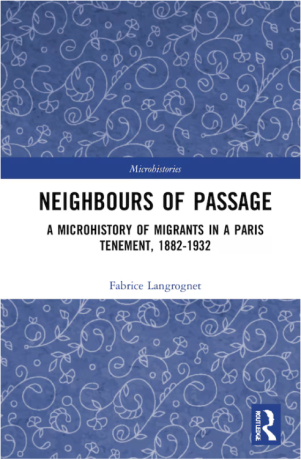
About: Fabrice Langrognet, Neighbours of Passage: A Microhistory of Migrants in a Paris Tenement, 1882–1932, Routledge
About: Fabrice Langrognet, Neighbours of Passage: A Microhistory of Migrants in a Paris Tenement, 1882–1932, Routledge

|
Because they are unstable, because they require moving over and over again with all the risks that this entails, the places of residence of exiles constitute sites of experimentation and fear, crossroads, convergence lines whose distant horizon is encapsulated in Perec’s evocative words: “How can I, who have no History, ever find a home?” Fabrice Langrognet’s book pays serious attention to this fantasy, which is tainted by profound doubt about what is to come. The author zooms in on an address in Saint-Denis—96-102 Avenue de Paris—and on the successive generations who lived there—between 1882 and 1932—to understand how one came to settle on that street, for how long, and after how many comings and goings; he identifies the multiple origins of the provincial, international, and colonial migrants who inhabited the place; and he looks at how men and women acted in this factory furnace.
The author’s epistemological choice ought to be clarified. Instead of starting with a profession, an industry, a corporation, a union, or a political protest movement to reconstruct the ebb and flow of different migratory waves, Langrognet focuses on a particular tenement block, thereby shifting the scale and perspective. What one sees through the buildings’ windows—family meals, relations among neighbors, children’s plays, school notebooks, rent prices—re-anchors questions of class, culture, and origin in both time and space. The interweaving into a single narrative of materials collected at different temporal scales (including the testimonies of seventy-five descendants of tenants) allows for rigorous observation, literary innovation, and a new perspective on the production of social categories. Three key concepts structure the narrative progression: variability, intersectionality, and agency. These correspond, respectively, to temporal and spatial fluctuations; systems of differentiation (origin, gender, race, class, religion, age, etc.); and individuals’ actions, whose combined effects cannot be understood in isolation from each other.
Let us put it another way. Watching the residents go down the stairs ten times a day, seeing them use the same outdoors toilets and hang out in the same street bars, helps us better understand how categories work and how people identify themselves, differentiate themselves from others, oppose and recognize each other, and act accordingly.
96-102 Avenue de Paris
The first part of the book describes the buildings, their demographic make-up, the migration trajectories of successive residents, and the modes of attachment and departure. The second traces the elective affinities, concrete solidarities, difference-based antagonisms, and interactions with public institutions that reshuffled identities in times of both peace and war.
Echoing Ruth Zylberman’s book and documentary film on 209 Rue Saint-Maur in Paris (Seuil, 2020) and Alaa al-Aswany’s novel about the Yacoubian building in Cairo (Merit, 2002, and Actes Sud 2006), the opening quote from Perec comes to life at the entrance to 96-102 avenue de Paris, in Saint-Denis, amid the smells of fertilizer, acid, and tallow emanating from the chemical factories of the Plaine.
Langrognet’s exploration of a tenement block located on the other side of the Paris fortifications allows him to construct a microhistory of migrations between 1882 and 1932. Our historian walks through the three doorways and into the successive courtyards in order to weave together and narrate several short life stories. These are the stories of the grocer, the coal merchant, and the fabric merchant; the stories of the buildings’ residents, tenants, and precarious occupants of different nationalities, who recounted their shared experiences in the three bistros that stood side by side on fifty meters of sidewalk (no fewer than 466 bars were listed in 1914 in the Plaine-Saint-Denis). As we read about the apartments and courtyards, the transformation of shacks initially set up as emergency housing, we get to see the Plaine’s industrial workers give each other tips on how to find a rental flat or a job for children recently arrived from Italy, Spain, or Alsace-Lorraine.
During the Belle Époque, the industrial suburb of Saint-Denis was a major attraction for the new migrants. Drawn to the place by offers of jobs and accommodation, the men joined their predecessors in the Plaine’s countless cafés, where they helped drive the black market of information and the exchange of leftover meat found on the canal wharves (the bones were turned into soap fat). While attractive to some, the area was repulsive to Parisians, for whom the slaughterhouses of La Villette and the nearby fortifications constituted an impassable border. The smells evoked the red banlieues, the blue overalls, the dormitories, the gas fumes, the possibility of danger. The fear of being robbed by men from Hainaut, Piedmont, or Old Castile prompted Parisian travelers to get off the tram in silence at Porte de La Chapelle.
Langrognet tells us about the crier of the Legras glassworks who, around midnight, shouted to the night staff to hurry up and get to work; Edmond’s family, Bernardo, and Lucie’s father, who built sturdy shacks in the back of the courtyard with money earned by working at Legras; Ernest’s parents, who managed a small business while waiting to take over the hotel-restaurant at the tenement’s entrance; the men who served as gambling hosts around the hotel-restaurant’s pool table at the end of the day; the subtenants of six-square-meter rooms and the newly arrived, homeless migrants crammed into twenty-square-meter apartments with two bedrooms for four people. A sense of opportunity fueled the dynamics of exchange. Family lines were infused with other businesses.
Opening the Minor Archives
With remarkable skill, Langrognet details the five buildings (each with five floors) and courtyards at 96-102 Avenue de Paris [1] and describes the residents’ concrete interactions with the administration of the city of Saint-Denis, the police, unions, schools, churches, and local businesses. All of these institutions had their own archives, which he investigated with the help of a large team. Whenever building No. 96, 98, 100, or 102 appeared in a document, the recorded moment was reported in the book—like a congealed event—regardless of its size, intensity, or fleetingness.
Citizenship applications? Langrognet studied them in detail and found that 300 had been filed by tenement residents (mostly men), with an overrepresentation—around 1890—of Alsatians and Lorrainers seeking to recover French citizenship and another—in 1930—of Italians and Spaniards who quickly understood the procedural strategies for settling permanently in the Plaine. All of the migrants had multiple identities. All had to maneuver to find their place, and the “we” grew larger with each expansion of a social circle.
The profound unity of the work lies in the way it investigates the intermingling of those tiny lives, the sociability and antagonistic cohabitation necessary to survive amid the wood stove smoke and the factory fumes that never left the ground. The author’s demanding and meticulous method is highly effective. Beyond the Perecian approach, Langrognet engages in an archival practice that consists of finding modest annotations in neglected collections—public health records, archives of local courts (justices de paix), land registers, censuses, probate and notary records, “analytical registers” of police stations, naturalization files, mutual benefit society records, school archives, municipal archives, and parish archives (for baptism records). Why open these minor archives? Because they cast shadows, illuminate backdrops, trace the outline of events, and light the way through many twists and turns. They contain a thousand stories that disrupt established narratives—a thousand incidents that mean more than they say.
These incidents implicitly tell us about people’s resourcefulness and about how it shaped the modes of inhabiting the buildings. They shed light on the paces of life, the attitudes towards health and hospitals, the ways of living as women and men, the ways of filling the cupboard (the first line of defense in times of shortage), and the habit of policing one’s neighbors (regardless of nationality). And they reveal the following: After the public baths were renovated, the women’s time was extended from one to two days; as soon as the Legras workers had collected their fortnightly wages at the cashier’s desk, they immediately headed to the “savings bank,” which is to say the wine merchant, to order a few bottles; when only three functioning toilets were available for fifty families at No. 100, tensions devolved into open conflict; whenever Louise Versigny, owner of several buildings, demanded “her rent money,” several families came together to discuss how they could pool their earnings and pay the rent in multiple installments. As it turns out, “la Louise Versigny” became known for her determination in taking her debtors to court: She did so no less than fifty-five times in a row. This goes to show that debt relationships took precedence over all other considerations and that they had the power to transform both alliances and feelings of belonging.
On the Margins of National Identities
Langrognet fully succeeds in his aim of writing a history of migration that takes “space” as its starting point. The spatial premise undermines the constructed nature of nationality and other identity assignments. It brings exchanges to the fore and situates the individual both in the flow of material and symbolic goods and in the opposition between the buildings’ internal force—dominated by social relations among residents (debts, gifts, and counter-gifts)—and an external force—governed by interactions with landlords, bosses, and leaders (a central problem being the payment or, more often, non-payment of rent). Spatial readings undo the presupposition of identity. Space triggers. Space provokes. Space leads to multiplicity.
The author proposes to delve deeper into buried archives and to intensify the search for the unexpected traces of a dense reality. Like Carlo Ginzburg before him, he suggests escaping the passion of nationality by observing the thousand bricolages and the opaque spaces that bring forth “horizontal contexts.”
Let us take the 466 bars of the Plaine-Saint-Denis. A first—lazy—reading would conclude from the turnover figures, the flow of supplies, and the tax rate applied that the businesses were doing well. And yet, there was another side to those bars. They were institutions in the sense that they served as headquarters for associations (whether of cyclists or of boule players), as boxing clubs, or simply as places where husbands deposited their fortnightly wages. The bar as an institution was on a par with the church and the school: It formed a third space where migrants—including women and children (except young girls)—could meet and organize, a stone’s throw from the public baths, whose patrons they could keep under watch, and six feet from the post office, where they lined up every other Saturday to send money back home. In the Plaine, bars were not separated by nationality. On the contrary, they were divided according to their patrons’ place of work: the gas company (“ceux du Gaz”), the slaughterhouse (“ceux des Boyaux”), the gun powder factory (“ceux des Armes”), and the boxing club (“ceux de la Boxe”). National and ethnic identities were blurred by other affiliations—particularly work and employment, the factory effectively serving as the Great Integrator.
The interweaving of roles, places, and economic opportunities also challenged the stigma attached to migration. The chapter devoted to Luigi Pirolli (1886-1953) makes this point beautifully. Luigi was born in the heart of Italy’s Mezzogiorno to parents who already had a culture of migration. Like thousands of other children, he migrated to the Plaine at age fifteen. He traveled frequently between France and Italy, and his various oscillations and identifications took him on numerous adventures in which growing social and cultural differentiation gradually erased his nationality. The more he moved around, the more his circle of friends expanded, and the more his agency—his room for maneuver—became tied to new social roles. Langrognet’s primary concern is clearly not to follow a cohort of Italians, a group of Spaniards, or a network of people from Franche-Comté, but to focus on an ecosystem wherein each individual had to find—and even to invent—his or her place in multiple spatial configurations. Rather than limiting the analysis to an artificially isolated community of belonging—whether Polish migrants or Afghan refugees—he grounds it in a street, concrete trajectories, multiple identifiable roles, unforeseen recordings, and a completely different economy of exchange.
Langrognet’s deep dive into 96-102 Avenue de Paris immerses us in the flows, the exchanges, and the circulation of women and men caught up in the machine. We see people moving to a different neighborhood in Saint-Denis or Aubervilliers, or making a trip to the home country or to another destination in France. And we come to understand that affinities at work, debt relationships, associative life, and solidarities are more effective than a supposedly sovereign ethnicity. What Langrognet demonstrates is that “minor archives” refute and disrupt the frameworks of order, identity, law, and classification.
Coexisting in the same space means facing hostility, conflict, and violence, but it also entails new urban opportunities and the possibility to form different kinds of bonds. As such, the tenement block provides a fascinating lens through which to explore labor migrations that created now-forgotten sociabilities and opened up new horizons. We must thank Langrognet for bringing these archival fragments back to life—as a detective would—in a way that dispels all univocal visions.
As early as 1980, Ginzburg noted in The Cheese and the Worms that “the scarcity of evidence about the behavior and attitudes of the subordinate classes of the past is certainly the major, though not the only, obstacle faced by the historian.” Langrognet overcomes this obstacle by searching through archives whose fragmented nature, apparent inertia, and opacity have deterred many a researcher. Microhistory aims precisely to reveal the other side of clamorous events—the sounds from below, the perceived cracks in the ground. In offering a way out of the trap of identity, it provides a new perspective on what people do with what is done to them.
Fabrice Langrognet, Neighbours of Passage: A Microhistory of Migrants in a Paris Tenement, 1882–1932, New York, Routledge, 2022. 218 p, 48 €
by , 18 November 2025
Share this article
Find us here :


To quote this article :
Jean-François Laé, « Through the Dusty Window of a Furnished Room », Books and Ideas , 18 November 2025. ISSN : 2105-3030. URL : https://laviedesidees.fr/Through-the-Dusty-Window-of-a-Furnished-Room
Nota Bene:
If you want to discuss this essay further, you can send a proposal to the editorial team (redaction at laviedesidees.fr). We will get back to you as soon as possible.
You might also like



Footnotes
[1] Those curious about the location can head to Campus Condorcet, get off at the Front Populaire metro station, walk 400 meters down Rue Proudhon towards the A1 highway to the west, and they will find themselves right in front of the buildings. Of course, they will have to imagine the place without the ring road, the A1 highway, the excavations, and the urban development.
Our partners


Sections
Keep in touch
© laviedesidees.fr - Any replication forbidden without the explicit consent of the editors. - Mentions légales - webdesign : Abel Poucet