


Have constitutions failed? While the Enlightenment gave birth to a faith in the power of constitutions, Lauréline Fontaine lays bare the myth surrounding constitutions and denounces the chasm between constitutionalism’s aspirations and how it works in practice.
The twilight of constitutionalism?
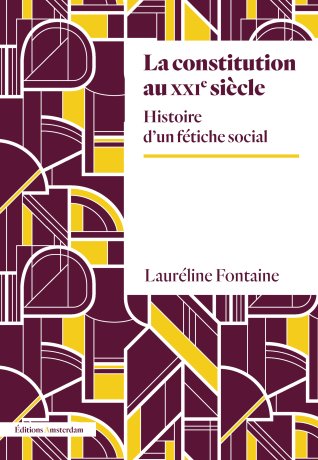
About: Lauréline Fontaine, La constitution au XXIe siècle. Histoire d’un fétiche social, Éditions Amsterdam
About: Lauréline Fontaine, La constitution au XXIe siècle. Histoire d’un fétiche social, Éditions Amsterdam

|
Constitutions on the defensive
Can constitutions change the world? This question, grandiloquent and naïve though it may be, lies at the heart of modern constitutionalism. When France and the United States adopted their first constitutions in the late eighteenth century, their avowed goal was to adopt new rules of government that were different from those that existed to bring about social transformation. Over time, these experiences were mythologized, resulting in a “grand constitutional narrative” which claims that constitutions are essential to limiting power and protecting rights and freedoms.
This belief in the usefulness and efficiency of constitutions has almost never been challenged from within the constitutionalist doctrine. [1] How could it, since this conviction is the discipline’s foundation? This is particularly true since the worldwide popularity of such documents would seem to confirm the myth. Absolutely every state has a constitution. This can take the form of a single document (as in Germany and Spain), or a disparate group of documents (as in France, where, in addition to the 1958 Constitution, there is also the 1789 Declaration of the Rights of Man and the Citizen, the preamble to the 1946 Constitution, and the 2004 Charter for the Environment). Constitutions also include unwritten customs and rules arising from practice and tradition, as well as the jurisprudence of constitutional courts. What matters is that there is at least a document that establishes the rules for distributing powers, consecrating rights and freedoms, and endowed with sufficient legal authority that it is respected by governments and guides their actions. This is the core logic of the rule of law.
Lauréline Fontaine seeks, however, to challenge these seemingly self-evident claims. Her book is intended as an incriminating accusation not only against the peddlers of this creed, but also constitutions themselves. Organized into five chapters, the book sets out to demystify constitutions by denouncing the promotional scheme launched in the late eighteenth century. Its ambitious approach and radical position make the book a rarity indeed. This writer’s acerbic style will already be familiar to many. Her previous book was particularly hard hitting. [2] Yet its target—the French Constitutional Council—was better known. In this instance, it is constitutions themselves that are placed on the defensive, a stance that is almost unprecedented in constitutional law. Consequently, the book is disturbing, astonishing, and striking. While a few reservations on some points are in order, it has the great merit of raising questions and presenting to the public in clear and accessible language [3] the paradoxes and impasses of modern constitutionalism.
Instrumentalizing constitutions
To this end, Fontaine begins with the first great myth: that constitutions arise from the will of the people. Constitutionalism presumes that state power originates with the people, as it is only on this condition that government can be legitimate. In fact, however, “no constitution promulgated until now has been written by the people” (p. 43). Drawing on the best-known historical examples, notably the US constitution, Fontaine shows that the people were always kept away from these documents. The pens that wrote these constitutions belonged primarily to a small group of men (and rarely women) whose intentions were by no means tied to preserving the general interest—quite the contrary.
The book shows the close connection between constitutionalism and the protection of economic interests, in that, from the beginning, the authors of constitutions assumed that they could not challenge such interests (p. 84). The importance of property rights in the first written constitutions illustrates this congenital relationship and lies at the root of the reciprocal dynamic between constitutionalism and economic growth. This connection has implications for understanding constitutions. First, it allows one to better understand the reticence of constitutional or supreme courts to take positions in favor of social justice and to allow it to produce its full effects (p. 104). Second—and most importantly—this economic philosophy contributes to the rise of a purely utilitarian conception of constitutions, in the sense that they are seen as resources rather than as instruments for limiting power.
The account of this conception of constitutions as resource versus constitutions as limit is perhaps the book’s most striking argument. Drawing on the recent but highly symptomatic example of the retirement reform in France, Fontaine shows how the French government used and combined legislative procedures in ways that turned the constitution into a means to strengthen executive power, at the expense of a stricter interpretation that would have preserved parliament’s deliberative role. This manipulation did not lead to mass opposition among constitutionalists, as most deemed that this approach did not violate the constitution. Fontaine reserves her harshest criticism for these constitutionalists. In chapter 3, she denounces their laziness and inclination to bend constitutions to the will of politicians rather than insisting that politicians obey them. While reading such arguments can be exhilarating, Fontaine’s criticism is not gratuitous and identifies the root of the problem: the separation of law and politics throughout the twentieth century, which has resulted in a conception of law as “disembodied and procedural” (p. 153), subjecting legal scholars and the legal field to the rule of neutrality which is not only impossible but poorly understood.
Misleading constitutions
Fontaine’s attacks could at first glance seem inconsequential, given that they concern such a small class of individuals, namely constitutional scholars. In fact, their position must be denounced, for by lending credence to the instrumentalization of constitutions, legal scholars justify the view that these documents are “exclusively the tools of the winner, but almost never the legitimate argument of the opponent” (p. 16). Is it enough for legal scholars to change their attitude to make constitutions appealing again? Chapter 4—which is both the book’s most powerful and most fatalistic chapter—vitiates this possibility. By returning to constitutionalism’s foundation, Fontaine defends the idea that this school of thought was always the expression of one group’s domination over another (p. 169). Of course, this domination is not always visible, precisely by virtue of the “idealizing force” of constitutional documents, but it exists. To make this point, Fontaine revisits the dark history of the Declaration of the Rights of Man and the Citizen (which is inseparable from the creation of an indirect election system with a property qualification, as well as slavery), landmark decisions by the United States’ Supreme Court that rationalized practices of domination (notably the 1896 Plessy v. Ferguson decision), and the colonial logic of constitutional practices (p. 187 ff). Through multiple examples found in the global history of colonialism, she illustrates the connections between constitutional rules and the perpetuation of relationships of domination.
This global survey allows her next to denounce the prevailing constitutional discourse, which masks constitutionalism’s dark history to celebrate its liberal and democratic character. Whereas some now defend the idea that there exists a “true” constitutionalism (that is liberal and democratic) as opposed to a “false” constitutionalism (which is only superficial façade for authoritarian power), Fontaine maintains that there exists neither “true” nor “false” constitutionalism but that these positions are just “narrative forms” that have no basis in concrete and tangible evidence (chapter 5). The will of constituents and legitimacy through elections, which are at times invoked to rescue liberal and democratic constitutionalism, are, for Fontaine, ploys to hide the profound inhumanity of constitutions. Her uncompromising analysis shatters idealized conceptions of constitutions as a “common home” that is the outcome of consensus accepted by all. Constitutions have never achieved such consensus and probably never will. They are, whether one likes it or not, the expression of one group’s will over another. This group may be large or small, but it remains only a portion of the population that constitutes a people.
Leaving the “constitutional cave”
At the end of the last chapter, readers may find themselves disconcerted, both by the force of Fontaine’s charge and the adamant nature of her conclusion. While one may often agree with her arguments, as when she denounces the international standardization of constitutions through the action of entities like the Venice Commission, several observations are in order. The first concerns Fontaine’s approach, which focuses on identifying constitutionalism’s major trends. This necessarily means that counterexamples are either rarely mentioned or minimized, which can be frustrating. It is a shame, for instance, that Fontaine occasionally equates ancient and more modern constitutions, while also accusing the latter of ineffectiveness. It seems fair to think that more recent efforts, notably in South America, have yet to reap the benefits they might yield over time. Moreover, while Fontaine is particularly hard on the recent trend to recognize the rights of nature, she barely mentions the question of constitutional feminism, despite its enormous potential to be transformative.
But beyond these considerations, the book’s most striking feature is the severity of its accusation: are constitutions really the root of all evil? Like any trend, constitutionalism has its limits. Constitutions exist to limit power but these limits, as is widely recognized, are relatively weak and apply only to the power of the state. But if the state’s power is not extensive (resulting, in other words, from a limited sphere of action and intervention), a constitution’s ability to limit it is reduced accordingly. It follows that it seems unreasonable to reproach constitutions for being ineffective when they are incapable of having an effect.
Most importantly, readers, upon finishing this book, will find themselves wondering about the future. The book tends to be fatalistic in its belief that the constitutional ethos is unchangeable. Is there no way to break with this history? Is it not possible to leave the “constitutional cave” and imagine a form of constitutionalism that is truly transformative (at the social level), or are we condemned to remain within it, in a state of sterile disenchantment? The epilogue suggests a possible path: that of recognizing the history and nature of constitutional law before considering the conditions for the emergence of a new form of constitutionalism that would acknowledge the social environment (p. 262). Doing so requires lucid examination of one’s own constitution and agreement on what is expected of such documents.
Reading Fontaine’s book is a first step in itself. There is no denying that such a hypothesis will take time and require open debate over controversial topics. It has already been several decades since serious debate about the organization of power and open discussion about institutional choices have occurred in France. Fontaine’s book has the great merit of reminding us of the stakes of this question and the risks of indifference. For this reason alone, her book is essential reading.
Lauréline Fontaine, La constitution au XXIe siècle. Histoire d’un fétiche social (Constitutions in the Twenty-First Century: The History of a Social Fetish), Paris, Éditions Amsterdam, 2025, 266 p., 20 €.
by , 26 November
Share this article
Find us here :


To quote this article :
Carolina Cerda-Guzman, « The twilight of constitutionalism? », Books and Ideas , 26 November 2026. ISSN : 2105-3030. URL : https://laviedesidees.fr/The-twilight-of-constitutionalism
Nota Bene:
If you want to discuss this essay further, you can send a proposal to the editorial team (redaction at laviedesidees.fr). We will get back to you as soon as possible.
You might also like


Footnotes
[1] For a recent example, see Anne-Charlène Bezzina, Cette Constitution qui nous protège, Paris, XO Éditions, 2024, 464 p.
[2] Lauréline Fontaine, La Constitution maltraitée. Anatomie du Conseil constitutionnel, Paris, Éditions Amsterdam, 2023, 280 p.
[3] The author also has a blog which contributes to making legal analysis available to the general public. See https://www.ledroitdelafontaine.fr/
Our partners


Sections
Keep in touch
© laviedesidees.fr - Any replication forbidden without the explicit consent of the editors. - Mentions légales - webdesign : Abel Poucet