


Despite being confined to diplomacy’s backstage, ambassadors’ wives were the invisible architects of France’s prestige abroad. From social receptions to soft power, Isabelle Dasque examines two centuries of feminine influence.
Marie-Madeleine Lioux, épouse de l’ambassadeur André Malraux, à l’inauguration du prêt de la Joconde à la National Gallery of Art, 1963
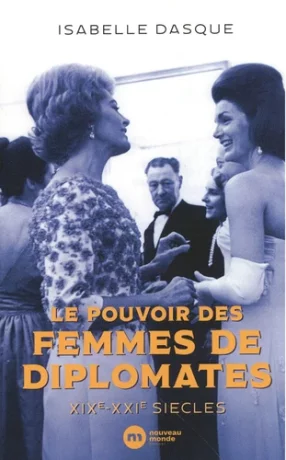
The discreet power of ambassadors’ wives
About: Isabelle Dasque, Le pouvoir des femmes de diplomates, XIXe-XXIe siècles, Nouveau Monde Éditions
About: Isabelle Dasque, Le pouvoir des femmes de diplomates, XIXe-XXIe siècles, Nouveau Monde Éditions

|
In the shadow of diplomats
“Is a diplomat’s wife not her husband’s most beautiful ornament, the feminine ideal of distinction, blending elegance with the frivolity of embassy salons? Is she ambitious, intriguing in her husbands’ shadows to reach the state’s pinnacle through the narrowest of paths? Behind the worldly lives of these professionals of appearance, one detects sighs full of ’diplomatic bovaryism’” (p. 11). Representations of ambassador’s wife abound in persistent stereotypes. They are perfect vehicles for light comedies and exotic novels, in which the ambassador’s wife is eagerly presented as having during the last century, “rekindled the flames of old embassies and taught a thing or two to attachés fresh out of the foreign service exam.” [1] In contrast to such fantasy literature, Isabelle Dasque, a historian specializing in the nineteenth century at Université Paris 1, proposes a different interpretation, emphasizing the power of diplomat’s wives. In a book full of anecdotes and testimonials, clearly structured around eight chapters conceived as the steps needed to marry a Quai d’Orsay diplomat, it paints a thorough portrait of these women who, despite their discretion, were unfailing promoters of France’s image abroad.
The book, which lies at the intersection of diplomatic, social, and gender history, relies primarily on personal records—memoirs, diaries, and correspondence between married couples—to pepper the argument with anecdotes from embassy life and document how these women constructed their identity in an historically aristocratic and male milieu. It is also a history of the diversity of their shared experiences: a long struggle for recognition, ranging from encounters with traumatic conflicts in host countries to legal considerations and salary fluctuations at the Quai d’Orsay (the French foreign ministry). The book also shows how these wives, despite a lack of official recognition, exercised considerable influence and paved the way for “diplomacy in a feminine mode” (p. 17), which was essential to expanding their country’s international influence in the nineteenth and twentieth centuries.
The ambassador’s wife’s exclusive domains
Dasque’s primary goal is to bring to light the essential but often overlooked role assumed by diplomat’s wives over the past two centuries. Their influence has been most significant in roles that, while unofficial and para-diplomatic, are nonetheless essential to ensuring effective exchange and national representation.
Soon after they had moved into their new quarters, these hostesses-in-chief of diplomatic residences became the custodians of assets that reflected French prestige. This implied logistical and managerial skills that some of the wives who were interviewed for the book compared to running a “small business” (p. 178), setting up a “headquarters” (p. 178), or being a “site manager” (p. 173). This was the primary realm of action for any diplomat’s wife, which evolved in synergy with the social life that inevitably revolves around an embassy. Nineteenth-century salons and dinners organized by ambassadors’ wives provided an essential context for exchanges, in addition to being the necessary condition for building a flattering image of the diplomatic couple and, more broadly, the nation they represent. In this way, the sensitive supervision of prestigious residences, like the Renaissance or baroque style palaces (Farnèse in Rome, Thott in Copenhagen), Arab-Islamic style residences (the Villa des Oliviers in Algiers), or structures inspired by local architecture (like the sub-Saharan style in Ouagadougou), with the help of the Mobilier National (the body that administers state furniture), contributed to putting French culture on display, even as diplomatic receptions also emphasized the host country’s architectural beauty.
Dasque insists, however, that the task of representing France assumed by diplomats’ wives consisted in more than pleasant socializing. The social life of the couple is, to the contrary, a crucial vehicle for French cultural influence. Consequently, soft power became one of ambassadors’ wives’ exclusive domains. Well before the institutionalization of cultural diplomacy, they had already taken on this role, which was destined to become genuinely important in the second half of the twentieth century. On this point, Dasque’s examples are numerous, but let us mention Nicole and Jenny de Margerie, respectively the wife and daughter-in-law of the French ambassador to Germany during the Jazz Age. Their approach to organizing salons, a Berlin microcosm that brought together members of the German intelligentsia (including E. M. Rilke, Walter Rathenau, Carl Sternheim), helped promote the “Europe of minds,” the cornerstone of the intellectual Locarno that completed the process of Franco-German rapprochement in 1925.
When even cultural diplomacy fails, there is, according to Dasque, a further domain in which diplomats’ wives find themselves on the frontline: humanitarian diplomacy. Whether it occurs in peace or wartime, the latter arises in response to a lack of state intervention: motivated only by their private initiative, wives occupy the terrain of social and philanthropic action. These include, in the first place, benevolent actions and fundraising, which are key examples of social engagements of a charitable nature: charity balls, performances, and races that provide direct aid to local populations and bolster the national community’s support. Secondly, the humanitarian actions of diplomats’ wives make it possible, in serious crises, to make up for the powerlessness of official policy. For Dasque, herein lies one of the undeniable powers of ambassadors’ wives: allowing France to preserve its influence without direct intervention.
Is unofficial power underestimated?
This “full-time job” (p. 248) consisting of many activities is an art of margins: the Quai d’Orsay understands the importance of ambassadors’ wives and the crucial support they provide their husbands and country but offers them no recognition. Is female power diminished as a result? To the contrary, Dasque sees this salutary uncertainty as a paradoxical advantage in carrying out their responsibilities, though one that varies from case to case.
The fact that they are not charged with diplomatic responsibilities recognized by the Ministry of Foreign Affairs gives spouses considerable latitude in interpreting and appropriating their role, in ways that “parallel and complement” their husbands’ work (p. 20). This very unique position allows ambassadors’ wives to forge freer relationships and become privileged informants, outside the usual channels. Moreover, Dasque believes that it is the very porosity of the boundary between formal negotiation and unofficial arrangements that makes backstage roles so important. Thus Laurence de la Baume, the wife of an embassy counselor in Poland in the early 1980s, used her lack of official status to pass on documents to the Solidarity trade union and help political dissidents be received on the other side of the iron curtain, despite the principle of non-interference to which every embassy is beholden.
Even so, highlighting this power must not overshadow the burdens of a responsibility that, while indispensable, is not perceived as such by the ministry. Extended passages are devoted to this theme, which explore the challenge of non-statutory labor as well as the “diplomatic citizenship” (p. 104) that these women must fight to achieve. The argument’s originality is twofold. First, it shows the precarious position in which diplomats’ wives long found themselves when they are widowed or divorced, in contrast to the romantic image of worldly aristocracy. Dasque describes the “schizophrenic and ambivalent” attitude (p. 269) on the part of Quai d’Orsay, where social guarantees and institutional recognition are often lacking. After a husband’s death, these women could not count on the remnants of a dowry diminished by diplomatic receptions—often paid for out of their own funds. From the nineteenth-century to the late 1950s, their only recourse was a fragile agreement between the Finance Ministry that allowed them to become tobacconists and enjoy the proceeds of this trade. The late twentieth century offered them more guarantees, notably a family supplement granted to the husband to compensate for the loss of his wife’s job. Yet this new legislation went hand-in-hand with the “pauperization of the Foreign Affairs Ministry” (p. 270) and the simplification of forms of representation. With specific thanks directed at spouses and experiencing diplomatic budget cuts on the front line, many say, with some bitterness, that they “chose a career” (p. 248) that comes with little gratitude.
The book is also notable for the way it presents ambassadors’ wives as pioneers in the feminist cause, some of whom kept their distance from embassy salons. Their marriage to diplomats could be a rare opportunity to escape various gender norms, such as travel and politics. Breaking through the confinement inherent to their status, these women were among the first to travel beyond Europe, creating for other women opportunities that had historically been seen as historically male. On this point, the portrait of Catherine de Bourboulon is instructive: a true explorer, she traveled, in 1861, more than 11,000 kilometers through “the cold winds of the Gobi Desert, Lake Baikal, and Siberia’s swamps” (p. 89). Her journey through Mongolia dressed in a man’s clothing inspired an author who had never been there: Jules Verne, who drew on her experiences for his novel Michel Strogoff. International experience and resulting openness to otherness also awakened, for many wives, an acute awareness of the condition of women in other cultures. Almost a century before the rise of “feminist diplomats,” Hélène Hoppenot wrote from Rio in a surprising free tone: “Women have yet to complete their evolution. One day, they will make their own laws [and] will be free to procreate without the awful scandal of having to abort. It will be their golden age” (p. 96).
Branding the nation
In addition to reevaluating the role of ambassadors’ wives, Dasque proposes an innovative analysis of diplomacy’s frontiers. Of course, women stood out by their absence from the Vienna Convention of April 18, 1961, which defined diplomatic relations between states, the immunity of diplomatic personnel, and the inviolability of embassies. They were also confined to the margins of typical diplomatic roles: “represent, protect, negotiate, inform, and promote bilateral relations” (p. 20). Even so, according to Dasque, their unofficial power went beyond para-diplomacy. They must be seen as an integral part of diplomacy broadly construed, in which a nation’s image is as important as foreign policy.
The “very public private lives” (p. 51) they lead pushed these wives to contribute relentlessly to a better image of the nation. It is often they who have best represented their country, benefiting from their greater freedom to keep the state informed of informal discussion and unofficial channels. Finally, they were the invisible architects of bilateral friendships because they understood early on that national prestige cannot be imposed but must be cultivated like a brand. The decision to focus on Nicole Alphand, the wife of the ambassador to the United States, emphasizes the extent to which she was able to make Kennedy’s American love France. “Washington’s premier hostess” (Life International, 1959) actively promoted French haute couture, culture, and gastronomy, preventing foreign competition from gaining ground. Dasque does not challenge the clichés associated with ambassadors’ wives but adds a new dimension to them: luxury and receptions become occasions to promote French brands, which have become an unavoidable form of influence.
Yet the promising title “the power of diplomats’ wives” allows a certain ambiguity to hover over this concept. The book’s entire appeal lies in the ambivalence of informal power, which oscillates between actual impact (as seen in humanitarian interventions in crises, public and media interventions, or instances of direct negotiation) and the unofficial influence of the kind discussed above. Consequently, readers are left uncertain as to whether these women should be thought of as genuine ambassadors, or simply as “daily collaborators” (p. 20), and whether their purpose is fundamentally different from that of their husbands.
Even so, the book makes an essential contribution to the understanding of diplomacy by rehabilitating a history that has been obscured at two levels: by the exclusively masculine character of ambassadorships until 1945 and, more recently, by the feminization of the diplomatic profession, as seen in the fact that, since 2002, the term ambassadrice refers to a female ambassador rather than an ambassador’s wife. By considering the many facets of the power exercised by diplomats’ wives, Dasque expands our definitions. Whether through soft power, influence, or cultural and humanitarian diplomacy, they have proved that there does not exist one but several kinds of diplomacy, in which their status as wives was and remains both discreet and fundamental.
Isabelle Dasque, Le pouvoir des femmes de diplomates, XIXe-XXIe siècles (The power of diplomats’ wives from the nineteenth to the twenty-first century) Paris, Nouveau Monde Éditions, 2025, 328 p., 23,90 €.
by , 22 September
Share this article
Find us here :


To quote this article :
Carl Petersen, « The discreet power of ambassadors’ wives », Books and Ideas , 22 September 2026. ISSN : 2105-3030. URL : https://laviedesidees.fr/The-discreet-power-of-ambassadors-wives
Nota Bene:
If you want to discuss this essay further, you can send a proposal to the editorial team (redaction at laviedesidees.fr). We will get back to you as soon as possible.
You might also like


Footnotes
[1] Roger Peyrefitte, La Fin des ambassades, Paris, Flammarion, 1951, cité par Isabelle Dasque p. 11.
Our partners


Sections
Keep in touch
© laviedesidees.fr - Any replication forbidden without the explicit consent of the editors. - Mentions légales - webdesign : Abel Poucet