


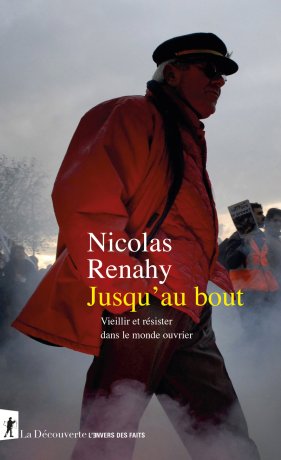
A five-year investigation reveals how the most militant blue-collar workers in Sochaux are growing older but continuing to stand up for their beliefs even after their retirement.
Old Comrades
About: Nicolas Renahy, Jusqu’au bout. Vieillir et résister dans le monde ouvrier, La Découverte
About: Nicolas Renahy, Jusqu’au bout. Vieillir et résister dans le monde ouvrier, La Découverte

|
It all started with a film from 1975, Avec le sang des autres (With the Blood of Others), shot in the immediate aftermath of May 1968 by Bruno Muel, with commentary by his wife, sociologist Francine Muel-Dreyfus. The film unflinchingly depicts and decries the harsh daily routine and working conditions of assembly line workers at the Peugeot factory in Sochaux, eastern France. A number of workers share their experiences. Among them is Christian Corouge, a CGT (General Confederation of Labor) union representative, who discusses the physical and mental toll that assembly line work takes on unskilled laborers. Between 1970 and 1973, he was an active member of the Medvedkine group in Sochaux, organized by activist filmmakers, including Chris Marker and Bruno Muel, to teach workers how to use a camera and make films. This group of workers went on to make five films.
Francine Muel introduced Christian Corouge to her colleague Michel Pialoux. The close friendship they formed led to a long-term collaboration between workers in Sochaux and several sociologists. First, Michel Pialoux published four articles with Christian Corouge in 1985 in the journal Actes de la Recherche en Sciences Sociales, entitled Chronique Peugeot. Then, in 2012, Retour sur la condition ouvrière was published [1]. Stéphane Beaud and Michel Pialoux analyze the trend toward individualized work at the Sochaux factory. The breakdown of social ties has undermined solidarity. The working class is increasingly divided along generational lines between older and younger workers, but also culturally between immigrants and French-born workers. Nicolas Renahy’s book continues this tradition. Thanks to his long-term investigation (2019-2024), we learn how the most militant workers in Sochaux are growing older but continuing to stand up for their beliefs, even after their retirement.
More than half a century working at Peugeot (55 years!) and three generations of sociologists. In each of their studies, the same person, Christian Corouge, plays a key role. He puts the sociologists in touch with his colleagues, attends interviews, and fosters a trusting relationship between the sociologists and the workers they interview.
Brotherhood and friendship
Over the course of their respective investigations, Michel Pialoux, Stéphane Beaud, and Nicolas Renahy stayed at Christian Corouge’s home. From beginning to end, this book is steeped in an atmosphere of friendship: between retired workers who are still activists, between activists and sociologists, but also between sociologists themselves. This mutual trust helped the respondents, who were not used to talking about themselves, to express often intimate details about their thoughts and behaviors, and allowed sociologists to pool all their archives. “It was quite amazing to meet Bruno Muel at the age of 17 and remain friends with him until the age of 72. That’s what the journey is all about, that’s what friendship is all about, that’s what camaraderie is all about,” says Christian Corouge.
The survey results are impressive. At the heart of the investigation is the CGT retirees group at the Peugeot factory. The retirees who have formed the group for the past 10 years (“the 89”) are the survivors of a generation of workers born before, during, or just after the war. With an average age of 70, they entered the labor market in the 1960s and 1970s. The 1968 protests had a profound impact on them. They have suffered greatly from numerous illnesses and disabilities, including blindness, deafness, lung infections, and musculoskeletal disorders, and lost many of their close friends and family members, several of whom took their own lives.
And yet they continue to resist, participating in meetings and demonstrations and, above all, showing total solidarity with their comrades day after day: they help each other, meet often, and encourage each other. These retirees never stop, enjoying visits to each other’s homes, drinks, walks, and conversations. Male friendships are mainly centered around manual activities. The members help each other out with DIY projects, home renovations, car maintenance and repairs, but above all, woodcutting. They live in one of the most densely forested regions in France. Going into the forest to cut wood is a common activity for many former Peugeot workers. Christian Corouge was allocated a plot of woodland under the affouage system, which, for a small fee, gives residents of a municipality that owns forests the right to fell trees and chop their own wood in a designated area of the forest. During the winter, he organizes wood-cutting days with a dozen or so friends, starting at 8 o’clock in the morning, with the men handling the chainsaws and the women stacking the cut logs, barbecuing, grilling chipolatas and merguez sausages, and taking photos. For the men, the physical exertion is a very important way of staying healthy in the open air. It gives them an opportunity to show that they are still fit and active and have lost none of their manual skills. Christian spends a lot of time in the forest and distributes the wood he cuts to his friends.
What about the women?
The working-class milieu is characterized by a very clear division of roles between men and women, both in the workplace and in the family. There are many varied obstacles that girls and women must overcome if they want to be free to choose their preferred path in their professional and private lives. It is not easy for them to break free from the control of their fathers and then their husbands. And yet, Nicolas Renahy has pieced together the stories of several retired female workers who show that, even before 1968, women were tenacious enough to break free from these forms of control. He has even collected very personal accounts of often painful events that had a profound impact on them. The paths they have taken to achieve this emancipation have been very diverse. But they all have one thing in common. None of them identifies with the feminism of urban, educated women; and none of them claims to be a “feminist.” And yet, through their actions and career paths, they have fundamentally challenged the highly gendered division of roles in the working class. They were determined to escape the status of “housewife.” They ignored their fathers’ and husbands’ refusal to allow them to pursue a career. They wanted to become independent by earning their own living.
Lili’s journey is an exemplary case. She had a difficult childhood as a “welfare case,” suffering from hunger and an alcoholic, violent father who left when her mother was pregnant. Pregnant herself and living with her partner at the age of 15, she and her husband became activists in the French Communist Party in the late 1950s. As the mother of four children, she refused to have any more and had two abortions. She joined Peugeot as an operating system engineer at the age of 30, against her husband’s wishes. She was promoted to CGT representative for her workshop, was very active in Secours Populaire, and became a municipal councilor in a town of 18,000 inhabitants. She quickly formed close friendships with a group of women through sports and hiking activities. Lili is now a widow, having lost her husband to suicide, and suffers from an incurable, degenerative lung disease. According to her daughter, she could “die at any moment.” Nonetheless, she continues to campaign, and took part in the protests against pension reform in 2023.
To avoid the difficulties of “talking about themselves,” other retired female workers discuss the importance of obtaining a driver’s license in their journey toward emancipation, their awkward introduction to sexuality and contraception, and their desire to take control of their own bodies, with abortion being seen as an act of resistance through transgression, and the status of single mother also being considered by some as a form of voluntary emancipation. Access to culture is another route to female emancipation. Having left school early after a bad experience, many retired women took advantage of the library set up by the Peugeot Sochaux works council, run by the CFDT and CGT unions, and a Communist Party bookshop that sold paperbacks. They read, and often a great deal!
A powerful collective
Christian Corouge gathered around him a group of men and women, all unique individuals with their own personal story unlike any other. Nicolas Renahy interviewed them one by one in private sessions. Each of them shared their stories and experiences of their unique personal journey. Yet Jusqu’au bout highlights a reality that goes far beyond the simple sum of these individual experiences. It presents us with a cohesive, united, and supportive group... right to the very end! The whole is greater than the sum of its parts. The book’s strength lies in its ability to convey the existence and power of this collective. Beyond the words recorded in interviews, the sociologist was able to enter this collective himself, and it was from within that he best understood its strength and its day-to-day functioning. He attended meetings, went to drinks parties at Clairette’s house and dinners, accompanied Christian Corouge to his friends’ homes, and answered questions from his interviewees. Over the five years that the study lasted, the workers grew accustomed to the sociologist’s presence. By simply being there, he was able to make himself invisible and bridge the gap between himself as an intellectual and the former laborers, whom many members of the CGT retirees’ section were initially wary of. He describes the atmosphere, acknowledging the strong bonds between some of them and the material and moral support they continue to give each other.
However, after retirement, not all CGT unionized workers joined the group formed and led by Christian Corouge. This was particularly true of two exemplary and highly committed activists, Georges and Hamid. The former was of peasant origin, while the latter was Tunisian. Why did they leave the collective? The strength of this joint, long-term investigation lies in Nicolas Renahy’s discovery of interviews that Michel Pialoux had already conducted with these two men in the 1990s. At the time, they were very active campaigners: the former was heavily involved in Communist Party activities, while the latter was president of the local branch of the Tunisian Workers’ Union, as well as a volunteer firefighter, soccer referee, and secretary of a pro-Palestinian support group. Retirement meant they could step back from all their activism. Nicolas Renahy and Christian Corouge caught up with them and had a long conversation. The profound changes that have taken place in the Sochaux company and in society as a whole, along with the rise of racism and the National Front, have dashed the hopes for social change they campaigned for all their lives. They now devote themselves to their families, their grandchildren, and activities such as DIY, hunting, and gardening in their immediate surroundings. They no longer believe in social change...
Resisting to the end
All in all, this is a compelling investigation that takes a long-term view, drawing on more than 50 years of research on the Sochaux site by Bruno and Francine Muel, Michel Pialoux, Stéphane Beaud, and Christian Corouge. Rich in friendships and perspective, it reconstructs the history of a militant counter-elite. It also raises the question of the role played by workers, particularly the least qualified, in trade unions and political organizations, where managers and graduates tend to monopolize elected positions and functions. And now that the generation who lived through the 1989 strikes at Peugeot is retired but still active, it examines how retirees are perceived and represented in French society. At the local level, we can see their role: for them, activism is also a way of fighting against illness, old age, grief, and loneliness. This cumulative story is a very moving one.
Nicolas Renahy, Jusqu’au bout. Vieillir et résister dans le monde ouvrier, Paris, La Découverte, 2024, 208 p., 21 €.
by , 9 October 2025
Share this article
Find us here :


To quote this article :
Christian Baudelot, « Old Comrades », Books and Ideas , 9 October 2025. ISSN : 2105-3030. URL : https://laviedesidees.fr/Old-Comrades
Nota Bene:
If you want to discuss this essay further, you can send a proposal to the editorial team (redaction at laviedesidees.fr). We will get back to you as soon as possible.
You might also like




Footnotes
[1] Stéphane Beaud and Michel Pialoux, Retour sur la condition ouvrière, La Découverte, 1999.
Our partners


Sections
Keep in touch
© laviedesidees.fr - Any replication forbidden without the explicit consent of the editors. - Mentions légales - webdesign : Abel Poucet