


At a time when Chinese capitalism is in search of an ethic, entrepreneurs are reinventing the old Confucian merchant.
Contemporary Confucian Capitalism
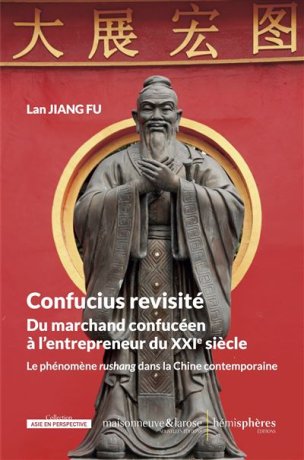
About: Lan Jiang Fu, Confucius revisité. Du marchand confucéen à l’entrepreneur du XXIe siècle, Hémisphères
About: Lan Jiang Fu, Confucius revisité. Du marchand confucéen à l’entrepreneur du XXIe siècle, Hémisphères

|
China has replaced Japan as the economic engine of East Asia, even as it has become the vanguard of global economic growth. This upheaval has given rise to a civilizational phenomenon that cannot be expressed simply in growth statistics. While many books examine China’s new geopolitical status, few consider the cultural or civilizational dimensions of its transition to capitalism and its new economic status. This is what Lan Jiang Fu sets out to do in her book, through an examination of Confucianism’s place in contemporary Chinese companies.
Religion in companies
Yet examining the place of religion in a capitalist company is hardly self-evident. In The Mental and the Material, Maurice Godelier, when considering employment relationships in the capitalist system, observed:
Apart from this material and impersonal dependence and submission within the production process, the worker owes the capitalist nothing, for he has no direct religious, political or familial obligation to him. Outside production, capitalists and workers are in principle equal, and this equality in principle is recognized by the law. [1]
In a modern capitalist society, economic functions thus occur in an institution—the company—that is separate from the political, familial, and religious functions. But as Michel Lallement notes, the foundational hypothesis of economic sociology is the “idea that economic activity and competition constitute a subset comprised in a societal context consisting of values, power, and social and relations.” [2] In this work of economic sociology, which is also a study of religious sociology, Jiang Fu documents the massive use, in small and medium-sized businesses, of religious and philanthropic discourses and practices by employers who claim to be Confucian.
From Japan to China
The question of the cultural dimension of company life and work relations has been examined in the case of Japan, particularly when it was at the peak of its economic glory in the 1980s and 1990s and was considered the model for other Asian countries, particularly as the rise of the so-called “dragons” (Taiwan, Hong Kong, Singapore and South Korea) inspired the idea of an “Asian model of capitalism.” Moreover, distinct Confucian dynamics were identified in each of these countries. Gilles Guiheux has shown in his important book on major Taiwanese entrepreneurs that various factors contributed to capitalism’s development in Taiwan: a work ethic, a tendency to save and be frugal, disapproval of leisure and laziness, respect for family, an emphasis on education (which is strongly associated with social mobility), and the belief that entrepreneurs have a collective responsibility and should contribute to national prosperity. [3] Japanese intellectuals and Japan scholars have, for their part, inverted Max Weber’s thesis in the Sociology of Religion, arguing that Asian religions and culture, and particularly Confucianism, far from delaying modernization, have in fact promoted it. [4] The most typical example of this literature is the economist Michio Morishima’s book, Why Has Japan “Succeeded”? [5] More recently, a book examined the Japanese entrepreneur and philanthropist Shibusawa Eiichi (1840-1931), who was perhaps the first East Asian to ponder the question of business ethics, notably in his most famous work, The Analects and the Abacus. What Jiang Fu shows is that, at present, China—which only thirty years ago had taken no part in reinventing the Confucian economic ethic—has taken the lead in what she calls “rushang fever.” [6]
Rushang entrepreneurs
The term rushang (儒商), which in contemporary China refers to entrepreneurs who sees their work as rooted in Confucian values, first appeared during the Ming dynasty (1368-1644), when it was used to describe merchants tied to cultured milieus who were steeped in Confucian ideas. Over three sections, Jiang Fu explores different dimensions of this phenomenon. First, she examines how this concept has evolved and been used since the Ming period and the type of people it refers to. Second, she considers what it means in contemporary Chinese companies, ranging from educational practices to business ethics in business relations, business practices, public health, and ecology. Third, she shows that this phenomenon is not limited to business, but has a political dimension that relates to nationalism, which fosters connections between political, economic, and intellectual elites. Part of the book’s strength lies in its exploration of various aspects of this phenomenon while drawing on extensive fieldwork, which allows Jiang Fu to discuss many specific cases and show the phenomenon’s great diversity.
Confucian ethics and economic rationality
The richness of her fieldwork also allows her to avoid the risk of turning managerial discourse into a cultural interpretation of the Chinese economy and companies. Through these cases, she shows that economic rationality is rarely missing in the practices of rushang entrepreneurs. An entrepreneur that she quotes who emphasizes the importance of virtue to a leader’s personality “considers that running a company is comparable to governing a country, and both depend on a leader’s virtue, for a virtuous man attracts ’men of talent’ [rencai 人才) more easily.” This phrase is drawn from Confucius’ Analects: “The rule of virtue can be compared to the Pole Star which commands the homage of the multitude of stars without leaving its place” (p. 157). If the entrepreneur seeks to acquire the qualities that Confucianism deems necessary to become a “gentleman” (junzi,君子)—humanity (ren, 仁), justice (yi, 义), propriety (li,礼), wisdom (zhi, 智), sincerity (xin,信), integrity (lian,廉), modesty (qi,耻), dutifulness (qin,勤), courage (yong,勇) and rigor (yan, 严)—it is because these qualities given them authority over workers. While employees do not appear in the book as much as entrepreneurs—the book’s main focus—they are not completely absent. Passages that convey their words or reactions to potentially intrusive practices suggest passivity and ambivalence, which are symptomatic of particularly unbalanced power relations. For instance, none of the companies she examines has a union.
In addition to being an original work in the sociology of religion, the book is also a major contribution to our understanding of the contemporary Chinese economy. While it does not explicitly present itself as contributing to these fields, it is also an intervention in the study of capitalism’s various forms and the circulation of ideas in East Asia. The book, which reads easily, is aimed at scholars as well as a broad reading public interested in the social and ethical issues relating to Chinese companies.
Lan Jiang Fu, Confucius revisité. Du marchand confucéen à l’entrepreneur du XXIe siècle (Confucius Revisited: From the Confucian Merchant to the Twenty-First Century Entrepreneur), Paris, Hémisphères, 2024, 352 p., €28, ISBN 9782377012091.
by , 20 October
Share this article
Find us here :


To quote this article :
Bernard Thomann, « Contemporary Confucian Capitalism », Books and Ideas , 20 October 2026. ISSN : 2105-3030. URL : https://laviedesidees.fr/Contemporary-Confucian-Capitalism
Nota Bene:
If you want to discuss this essay further, you can send a proposal to the editorial team (redaction at laviedesidees.fr). We will get back to you as soon as possible.
You might also like


Footnotes
[1] Maurice Godelier, The Mental and the Material: Thought, Economy and Society, London, Verso, 1986 [1984], 232-233.
[2] Michel Lallement, “Renaissance de la sociologie économique,” Sociologie du Travail, February 1996, p. 215.
[3] Gilles Guiheux, Les grands entrepreneurs privés à Taiwan. La main visible de la prospérité, CNRS Éditions, Paris, 2002.
[4] See Thomas Brisson, “La réception Des écrits De Max Weber sur le confucianisme au Japon et en Asie Du sud-est : Contextes socio-politiques et dynamique formelle d’une thèse (années 1930-1980),”
Revue d’anthropologie des connaissances, 10, n° 2(2), 2016, p. 303-320.
[5] Michio Morishima, Why Has Japan “Succeeded”?: Western Technology and the Japanese Ethos, Cambridge University Press, 1984.
[6] For a review of Patrick Fridenson and Kikkawa Takeo’s edited volume, Ethical capitalism: Shibusawa Eiichi and Business Leadership in Global Perspective, Toronto, University of Toronto Press, 2017, see Bernard Thomann in Revue de Synthèse, 2019.
Our partners


Sections
Keep in touch
© laviedesidees.fr - Any replication forbidden without the explicit consent of the editors. - Mentions légales - webdesign : Abel Poucet