


Under the old regime, abortion did not exist as a distinct legal category. Yet it was practiced and criminalized when associated with sexual transgressions. How does one write the history of an unimagined concept and a hidden practice?
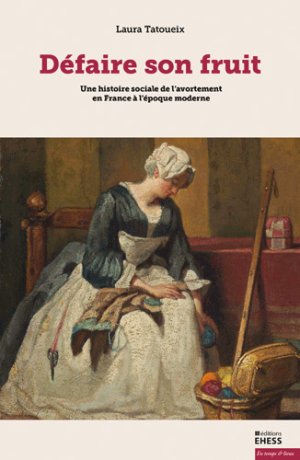
“La brodeuse”, Jean Baptiste Simeon (1699-1779)
Abortion under the Old Regime
About: Laura Tatoueix, Défaire son fruit. Une histoire sociale de l’avortement en France à l’époque moderne, éditions de l’EHESS
About: Laura Tatoueix, Défaire son fruit. Une histoire sociale de l’avortement en France à l’époque moderne, éditions de l’EHESS

|
On September 28, 2024, Pope Francis told a group of journalists: “An abortion is a murder. Doctors who do that are—allow me to use that word—contract killers.” His statement belongs to a theological tradition that goes back to the Church Fathers that has nothing to say about abortion as such before the seventeenth century. Instead, it equates abortion with infanticide, parricide, and homicide. Laura Tatoueix’s history of abortion considers, in the first place, the cultural conditions that constituted the framework of this practice.
The late pope ignores, in fact, internal debates within the Church. On the one hand, theologians, councils, synodal statutes, and confession manuals have historically distinguished “inanimate” from “animate” fetuses—that is, fetuses endowed with a human “soul.” Only the killing of an animate fetus was deemed a crime. While the limit of “animation,” considered to be forty days (at a time when no way of dating the moment of conception existed), was arbitrary—and independent of scientific knowledge—this distinction, which was reexamined in light of scientific developments, altered Church discourse without leading to a total rejection of its earlier stance. Even so, the Church has always feared that the slightest concession might appear to legitimate abortion. Consequently, it has wavered between acceptance and repression of various conciliatory practices—from the killing of inanimate fetuses or, in the case of living newborns, baptisms and emergency baptisms intended to ensure eternal life, thus mitigating the crime. On the other hand, beginning in the second half of the sixteenth century, Jesuit casuistry began to consider special cases, notably relating to the social and medical condition of mothers. The pope ignored this tradition too—which was, incidentally, stigmatized as soon as it was formulated.
There is theory, but there is also practice. According to the World Health Organization, between 39,000 and 47,000 women die each year from non-medical abortions. The figure’s uncertainty calls attention to the fact that, even today, abortion is secretive and remains a practice that is difficult to grasp. It is even more difficult to do so when dealing with earlier periods.
An unnamable practice?
How does one write the history of a concept that was ill-defined to men and women of the past and who did not refer to it in the same terms as the present? Theologians and legal scholars made no distinction between infanticide and abortion. Women almost never spoke of abortion but rather of a desire to “empty their fruit,” “evacuate”, or even (suggesting that they were unaware or in denial about their pregnancies) “reverse one’s period.” Furthermore, how does one write the history of a hidden practice? One historiographical tradition has long maintained that abortion did not exist under the old regime, on the assumption that a lack of evidence can be understood as respect for religious dogma.
While historical demography has long concluded that low rates of illegitimate births and significant illicit sex implied the use of contraceptive procedures and/or abortion, no French study had yet to connect this topic to the history of criminality and the history of the body—in other words, to the emergence of a concept and a practice. [1] The merit of Laura Tatoueix’s book is to argue persuasively that it is possible, without being teleological, to examine the forms whereby what we call abortion was conceived and experienced before it could be articulated as such. Though it could not be named, the practice nonetheless existed, and contemporaries were aware of it. The infrequency of judicial cases even testifies to a degree of societal tolerance (strict enforcement of doctrine notwithstanding) and institutional tolerance for the practice.
Henry II’s edict, or intention presumed
In addition to religions definitions of abortion as a sin, the book examines the development of secular legal norms relating to the practice and their application. The crime, which was never addressed per se in legal literature, was conflated with other crimes: the crime of encis (an aggravated form of murder, directed against a pregnant woman and resulting in the death of the mother or the fetus), [2] as well as those of poisoning, parricide, and suppression de part (that is, the murder of an infant immediately after its birth, which, beginning in the seventeenth century, became known as infanticide). The reason for this lack of specificity seems to have been tied to the difficulty of proving abortion and describing it in medical terms, in ways that might have given rise to its own jurisprudence.
Abortion’s judicial career rests primarily on a 1557 edict (which was reaffirmed in 1586 and 1708), which sought to condemn not the intentional murder of a fetus (which was generally impossible to prove), but women “reputed” to be murderers when their child died and they hid its birth and their pregnancy by neglecting to announce them. The edict focused solely on pregnant women, excluding their progenitors from primary responsibility, but including abortionists (doctors, surgeons, apothecaries, matrons, and so on). Its implementation testifies to the secularization of law: first, because lack of evidence of baptism, which was one of the edict’s criteria, seems in most cases not to have been invoked; second, because it replaced the distinction between “animate” and “inanimate” fetus with an emphasis on (presumed) criminal intention, irrespective of the fetus’ condition; and third, because it placed suppressions de part under royal jurisdiction (though ecclesiastical tribunals still tried some cases in which priests were defendants).
A history of legal practices
To the extent that abortion was not a legal category under the old regime, it can be identified only through the forms of criminalization laid out in Henry II’s edict (notably hiding pregnancies and suppression de part). Tatoueix bases her analysis on 50 procedures [3]: 38 invoked the provisions of Henry II’s edict and covered abortion and infanticide indifferently, even if the specific question of abortion was occasionally raised during the trial. The truth, however, cannot be established.
In cases when children died after being carried to term, infanticide was presumed or even considered proven if their bodies bore clear marks. In the case of fetuses not carried to term (miscarriages or abortions), if the pregnancy was not announced, the women could claim that they would have done so at some later point in the incomplete pregnancy. In such situations, presumptions (in the absence of a confession or unambiguous testimony) are impossible. While the edict allowed for the death penalty, judges, in practice, either released the defendants or charged them with minor crimes (a procedure known as “plus amplement informé”—though the book does not say whether they were released or not). The defendants were girls or widows who had not announced their pregnancies. For married women, there was no such thing as abortions during the old regime. Abortion existed as a crime only in the context of sexual transgressions.
The archives have primarily preserved traces of accusations against women from underprivileged backgrounds. Their pregnancies often resulted from an asymmetrical and/or violent relationship (the progenitor being, perhaps, a master, priest, or rapist), including incestuous ones. Furthermore, various exceptional procedures specifically targeted abortionists. Their archives can be found at the Bastille, and, in the case of the 1679-1682 Poisons Affair, at the Arsenal, extending until 1711. They show that recourse to abortion was prevalent at all social levels, including adulterous married women.
Late eighteenth-century innovations
In the second half of the eighteenth century, Henry II’s edict came under attack from several directions. It was accused of inefficiency: those who were concerned with depopulation worried that an edict that sought to discourage women from committing crimes against their children (whether born or about to be born) had resulted, some believed, in a growing number of abortions and infanticides. Awareness of the crime’s social context made it possible to understand why women were compelled to commit such actions. Influenced by Beccaria and drawing on ideas that had already been expressed during the seventeenth century by Pierre Bayle, some reformist legal scholars emphasized the role played by the negative image of illegitimate pregnancies in abortion practices focused on preserving a woman’s honor.
The redefinition of crime is particularly influenced by the renewal of médecine légale—a term that appeared in 1777—in other words, forensic medicine. In 1732, the first post-mortem examinations of abortions occurred. While experiments on bodies did not decide the question of whether a fetus that was not carried to term could breathe and thus be considered to have been murdered, reflection about the fetus’ viability made it possible to distinguish abortion from infanticide. In the 1791 Penal Code, the two concepts became distinct.
The book openly adopts the perspective of the history of ideas, at the risk of quashing intellectual disagreements and conflicts tied to specific social and institutions positions, proposing a not particularly linear history that gradually leads towards increasing secularization and a greater role for science, as well as empathy. Yet the connections it identifies between procedures and practice is particularly effective.
An intimately female experience
We have no first-hand sources that convey the private experience of having an abortion—including all the failed and silent efforts—during this period. Abortion practices (which were rarely mechanical and were often medicinal or even magical) were rarely effective. The women who attempted to abort their pregnancies unsuccessfully and left no trace lie beyond the purview of judicial records.
Judicial records do, however, allow Tatoueix to understand abortion’s causes. The main reason is to preserve honor, while the question of whether the child is wanted or economic circumstances making having a child difficult are harder to discern. Tatoueix also notes that, in the sources, prostitutes remain invisible, despite being particularly exposed to undesired pregnancies.
Indirectly, the history of illegitimate sexuality is also the story of efforts to limit legitimate pregnancies—not through abortion, but through abstinence and withdrawal. This was, of course, impossible for women who found themselves accused of suppression de part and who were impacted by hierarchical relationships. The nature of these relationships, the vulnerability resulting from illegitimate pregnancies, and the need to confine oneself to (supportive or mercenary) abortionists, made abortion the final link of a continuous chain in which women’s bodies were neglected and removed from their own desire and control. Of course, some women (particularly those belonging to privileged milieus) initiated their own abortions. Yet Tatoueix believes that this is insufficient grounds for interpreting them as spaces of agency. The history of abortion belongs, rather, to the history of the religious, moral, and male control of female bodies.
Laura Tatoueix, Défaire son fruit. Une histoire sociale de l’avortement en France à l’époque moderne, Paris, éditions de l’EHESS, coll. En temps & lieux, 2024, 392 p., 22,80 euros.
by , 4 November 2025
Share this article
Find us here :


To quote this article :
Déborah Cohen, « Abortion under the Old Regime », Books and Ideas , 4 November 2025. ISSN : 2105-3030. URL : https://laviedesidees.fr/Abortion-under-the-Old-Regime
Nota Bene:
If you want to discuss this essay further, you can send a proposal to the editorial team (redaction at laviedesidees.fr). We will get back to you as soon as possible.
You might also like


Footnotes
[1] Tatoueix’s study was written in the wake of Cathy McClive’s Menstruation and Procreation in Early Modern France, Farnham, Ashgate, 2015.
[2] Translator’s note.
[3] These procedures are found in Series B of eight departmental archives (primarily to the south of the Île-de-France and in the Orléanais) and in the archives of the officialité (church court) of the Oise.
Our partners


Sections
Keep in touch
© laviedesidees.fr - Any replication forbidden without the explicit consent of the editors. - Mentions légales - webdesign : Abel Poucet