


What bitter knowledge travel brings! In fact, why travel at all? And can we inhabit the world while journeying through it?
The Traveler’s Ennui
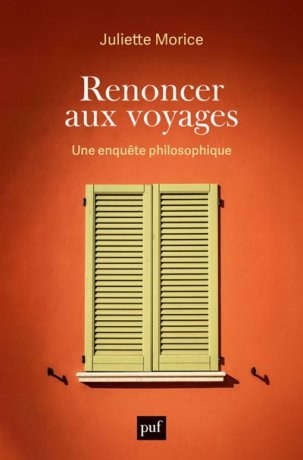
About: Juliette Morice, Renoncer aux voyages. Une enquête philosophique, Puf
About: Juliette Morice, Renoncer aux voyages. Une enquête philosophique, Puf
by ,
23 July 2025
translated by
|
Do we ever travel for the right reasons? In her new book Renoncer aux voyages (“Forgoing Travel. A Philosophical Inquiry”), Juliette Morice, a philosopher specializing in the history of travel from the sixteenth to eighteenth centuries, invites us to challenge the discourse urging us to stop travelling—especially by plane—in order to save the planet, by drawing parallels with historical debates on the usefulness of travel dating back to the Renaissance. Manuals on “the art of useful travel” (p. 12) proliferated between the sixteenth and seventeenth centuries. However, doubts about the meaning and purpose of travel persisted throughout the European Enlightenment until the advent of Romanticism, only to re-emerge with a vengeance in the face of rising mass tourism. The author explores the paradoxes and disappointments of travel, both in the imagination and as an experience of dust, sweat and hazards. Yet she does not conclude that the act of travelling is futile, much less harmful. On the contrary, through the reflections of author-travelers as varied as Montaigne, Chesterton and Michaux, she suggests that travel should be understood as a means of inhabiting the world: we wish to travel in order to inhabit it in a certain way, by moving through it fleetingly, without taking root in it or—although this is less certain—appropriating it for our own purposes.
What is travel?
Before we can decide whether or not travel can be useful, we need to agree on what travelling means. The criteria for distinguishing travel from other kinds of mobility are far from obvious. Quantitative criteria, such as distance traveled or time elapsed, run up against the “problem of measurement” (p. 54): at what distance or duration can we say that we are traveling? Is it necessary to go far away in order to travel? Morice contrasts two “conceptions of travel” (p. 112): one that places travel in the context of continuity and associates it with slowness and simplicity, and the other that takes discontinuity as the criterion of travel and emphasizes distance and speed.
Travel could be defined by the process of transportation as much as by its destination, however: might this process not be the true purpose of the journey? The author notes that, in locomotion, the traveler gains access to a “paradoxical tranquility” (p. 110) “conducive to dream or meditation” (p. 119): the young Marcel Proust contemplating a blue blind on the train to Balbec, or the airline passenger lost in the clouds. Montaigne, before them, saw his journey to Italy as “movement itself” (p. 56). Morice thus contemplates the hypothesis, first put forward by Diderot, that all travel stems from the simple “physical need to make a journey” (p. 103), to expend energy, to stay on the move. As “movements devoid of meaning” (p. 106), journeys would then be made without reason.
If we can travel very close to home, is it not better to replace these deceptive quantitative criteria with the qualitative criterion of strangeness or estrangement? We travel as soon as we perceive “a space as someplace else” (p. 61). Crossing the frontier associated with travel would then be primarily symbolic: taking a tour of one’s own room can be more awe-inspiring than a world tour, if one only knows how to see. But travel has other qualities that bring it back to the realm of duration, distance and effort: the traveler is free (and not confined to a room), and the journey undertaken is usually marked by memorable actions and adventures that are “worthy of being told” (p. 63). Here, travel’s constitutive relationship with narration on the one hand, and nostalgia on the other, comes to the fore.
An eventful journey is paradoxically both “desired and feared” (id.). It is anticipated in the traveler’s imagination and recounted once it is over. Is the traveler motivated only by the prospect of being able to recount their journey? The reliability of such accounts, and the risk of inaccuracy, exaggeration and confabulation, were a source of constant preoccupation for Enlightenment philosophers. Furthermore, Morice shows how travelers’ propensity to lie stems from a “collective expectation” (p. 228) of travel, which is always supposed to be exotic, surprising and novel. What can be said about travel when nothing happens? Does it really count as travel? Conversely, perhaps words and imagination are enough to make people travel. Suspected of never having boarded the Trans-Siberian railway, Cendrars retorted: “What does it matter to you, since I made you all take it!” (p. 233).
Travel as an epistemological obstacle
In the controversy over the usefulness of travel that occupied Europeans between the sixteenth and eighteenth centuries, those who argued that travel was futile claimed that it exposed people to death and moral corruption, and that it served no purpose other than to fuel the smugness of those who returned. For philosophers, the greatest failure of travel lay in its failed relationship with knowledge. The argument over travel was thus as much scientific as moral: could travel offer a “‘good’ outlook on the world” (p. 69)? When travelers are not accused of being driven by vain curiosity, they are criticized for not knowing “where to look” (p. 67) for lack of a method. On his return from Russia, Diderot wrote:
It requires a long sojourn to know the most common phenomena with any degree of accuracy; and the traveler who, at every turn of the wheel, scribbles a note on his tablet, has no idea that he is writing a lie; yet that is what he is doing (quoted p. 227).
The problem of confabulation is essentially one of an inability to see. In an attempt to guard against this, Rousseau developed his own art of useful travel in Emile: his pupil would not travel “to see the country” (quoted on p. 75), driven by a naive fascination with difference or foreignness as such. Through the methodical observation and comparison of countries, customs and governments, he should acquire a general knowledge of humankind. Morice shows that Rousseau’s approach was “antiexotic”, in contrast with the embellished narratives of his contemporaries. The aim of travel was not to “experience diversity as such”, but “on the contrary [to] disregard it”, to “take away the differences” (id.) in order to arrive at what is common.
Here lies “the constitutive problem of travel: how to gain knowledge of the other?” (p. 195). In claiming to solve this problem by reducing differences to sameness, as Rousseau does, are we not, in the end, ignoring and blinding ourselves to the specificity of the other—whether country, government or human? Travel as a dream opportunity for knowledge ultimately confronts us with the impossibility of “knowing an object as unknown” (p. 199). Lévi-Strauss reflects on this impossibility in Tristes Tropiques, when confronted with the “strangeness” of the Mundé people of Brazil, whom he deems just as disappointing in their impenetrability as in their reducibility to the known. The traveler’s knowledge of a foreign culture is rendered equally impossible by their situation: as an outside observer, they modify what they observe since, by their very presence, they are forcing it to be seen. In Phantom Africa, Michel Leiris is filled with the suspicion that the rituals witnessed are fake and that he might after all be a tourist like any other.
So, why travel at all? If it is naive to believe that we will learn more about a culture or a country by going there, perhaps it would be better to stay at home. Is the enjoyment we derive from it a good enough reason to travel? A typology of travelers and their motivations gradually emerges from the book.
Mapping the travelers
Given the obstacles that travel poses to the quest for knowledge, some argue that we travel better without actually going anywhere. Morice points out that it is not so paradoxical that Kant the cosmopolitan never left Königsberg. The philosopher’s sedentary lifestyle was the culmination of his demand for methodical knowledge: systematically reading works on foreign cultures is seen as a far more effective way to travel than the incomplete notes taken on the spot “at each turn of the wheel”. Kant was not the only stationary traveler. Petrarch traveled by imagination, Édouard Glissant, “by proxy” (p. 94): unable to travel to Easter Island, he created a travel book from the notes and photos his wife collected there for him. Montaigne, however, pointed out that one cannot travel without experiencing the world first-hand, even in its repulsive materiality. Bougainville, for his part, was irritated by the comfortable, overbearing immobility of philosophers, who denied “the faculty of seeing and thinking” to the very travelers whose observations they took up (quoted on p. 230).
With the arrival of Romanticism, the object of the quest for knowledge shifted: it was the self that was sought through travel, or rather the place that would finally correspond to the subject’s inner state. Morice notes the link between travel and melancholy, described by Starobinski as “an unhappy relationship with space” (p. 45). The search for the right place is just another name for the desire to escape from oneself. “It seems to me that I will always be happy in the place where I am not”, Baudelaire wrote in his poem “Anywhere Out of the World” (quoted. p. 237). Here again, travel seems doomed to failure. We always encounter ourselves at the end of the journey, and we never feel at home anywhere. Seneca thus linked the movement of travel to our “natural restlessness” (p. 161), suggesting that the wise man, master of himself and “everywhere at home” (p. 167), can easily do without travel.
If we do not wish to forgo travel, we can invoke the pleasure it brings. Montaigne embodied this figure of the curious and inconstant traveler, who enjoyed traveling to “rub and file [his] brains against those of others” (quoted. p. 56), to roam adventurously, to experience change. Morice considers Montaigne an alternative to the Stoic ethic of immobility: to travel is to learn to find one’s “place” (p. 128), like a horse rider on his mount. First thrown off balance by a new language and customs, the traveler adapts by integrating these “foreign things” (quoted on p. 127) into his experience and achieves stability through movement.
Tourism and nostalgia
Is the tourist the contemporary version of the curious traveler, then, or rather its perversion, half-ogre and half-philistine? Morice examines the commonplace notion that the tourist is a bad traveler. Unadventurous, inauthentic, consumerist, destructive, popular—tourism is all that remains of travel when travel becomes impossible. The “fantasy of possessing the world” (p. 77) drives tourists to accumulate landmarks and photos, or, like the lovers of the Pont des Arts or Chateaubriand at the Parthenon, to indulge in vandalism. The tourist’s purpose is to be able to say, ‘I was there’ (p. 181). The author wryly reminds us that “tourists are always others” (p. 177): on the lookout for “non-touristy” places (p. 185) in which to gain a more authentic experience, they too are fleeing from themselves. Without minimizing the pernicious social and ecological impact mass tourism, Morice points out that the difference in kind between travel and tourism is a myth.
There is no such thing as the “truth of travel” (p. 191), revealed only to great explorers and inaccessible to today’s tourists, who are doomed to move around in a grid-like space. This dubious mythology of discovery is encapsulated in the following sentence by Baudrillard:
A period when there were still barbarians and savages to discover was followed by an era when the Earth became a globe, travel came to an end and tourism began, in other words, an era when all we can do is travel around a world that is already known. (quoted on p. 44)
Morice shows that the theme of the “end of travel” takes on “two forms of nostalgia” (p. 28). First, nostalgia for an untainted experience of space and movement, before the acceleration of means of transport—as if slowness were a source of truth and value. Second, nostalgia for a world without known limits—as if the sphericity of the earth represented “the exhaustion of the world” (p. 16). From the end of the sixteenth century onwards, trade and communication between the different parts of the world were seen as instruments for unifying the world, or, to use Lévi-Strauss’s terms four centuries later, contaminating it. “True voyages” (p. 191) have always been a thing of the past.
This intrinsic link between travel and nostalgia is also evident in the constant anticipation that punctuates the traveler’s movements. Anticipating our return, we travel to “build up a reserve of memories” (p. 144) and a “reserve of images” (p. 180). But also, anticipating recognition, we travel “to see again, to recognize, to check, to revisit where others have been” (p. 18). Think only of tourists who walk through museums, seeing works of art only through their camera lens. More than a discovery or a change of scenery, travel is an opportunity for “reunion” (p. 210) with collective imaginings as well as with one’s own imagination.
Forgoing travel today
While many others before us have given up traveling, the present-day prospect of the end of travel is nevertheless framed by the specific threat posed by climate disruption to the Earth’s habitability. At several points in the book, Morice questions the moral appropriateness of limiting our air travel or making certain sites inaccessible in order to preserve them from destruction. Without directly answering these questions, the philosopher emphasizes the freedom that comes with travel. “A triumph over gravity” (p. 124), the airplane is itself a symbol of such freedom: does it not enable human beings to fly away? Like the hot-air balloon before it, it measures both “human power” and “human insignificance before the immensity of the world” (p. 125).
It follows that limiting air travel not only amounts to “self-imposed punishment” (p. 47), but also to a disavowal of a part of our humanity. By inflicting on ourselves the penalty we believe our hubris deserves, we are also renouncing “a form of Promethean greatness that is quintessentially human” (p. 126). The freedom that Morice praises is not only that which results from technical mastery. It is the freedom of movement itself, which is the reason we inhabit the earth:
Inhabiting the world requires being able to move around in it, not just taking root in a stable location or choosing a particular place as a point of reference. (p. 241)
The reason for travel, then, lies in the human desire to inhabit the world by journeying around it. However, this observation does little to resolve the contemporary traveler’s dilemma in light of the devastation air travel causes, or to help us fully grasp the unprecedented nature of this dilemma in human history. In this respect, the reflections of the European Renaissance and Enlightenment on the usefulness of travel reveal above all the vast moral and political grey area in which the current ecological crisis has left us. If we are to continue inhabiting the earth, we will in any case have to forgo traveling, at least in the manner to which we have grown accustomed over the past century. In this beautiful book, Juliette Morice also helps us understand that the future of travel will, as always, have to be imagined.
Juliette Morice, Renoncer aux voyages. Une enquête philosophique, Paris, Presses Universitaires de France, 2024, 247 pp., €20.
by , 23 July 2025
Share this article
Find us here :


To quote this article :
Juliette Roussin, « The Traveler’s Ennui », Books and Ideas , 23 July 2025. ISSN : 2105-3030. URL : https://laviedesidees.fr/The-Traveler-s-Ennui
Nota Bene:
If you want to discuss this essay further, you can send a proposal to the editorial team (redaction at laviedesidees.fr). We will get back to you as soon as possible.
You might also like


Our partners


Sections
Keep in touch
© laviedesidees.fr - Any replication forbidden without the explicit consent of the editors. - Mentions légales - webdesign : Abel Poucet