


Architects are making the earth uninhabitable. Rather than reusing materials that already exist, they push for greater resource extraction and produce waste that cannot be recycled.
For a sustainable architecture
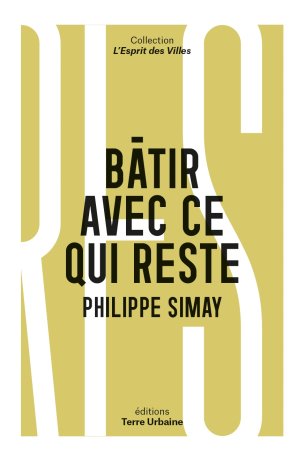
About: Philippe Simay, Bâtir avec ce qui reste : quelles ressources pour sortir de l’extractivisme ?, Éditions Terre urbaine
About: Philippe Simay, Bâtir avec ce qui reste : quelles ressources pour sortir de l’extractivisme ?, Éditions Terre urbaine

|
In his new book, Philippe Simay, an associate professor of philosophy at the École Nationale Supérieure d’Architecture de Paris-Belleville, proposes an ecological critique of “extractivism” [1] in architecture that is likely to disturb many practitioners. His book follows the publication in 2022 of a work, coauthored with Clara Simay, [2] that described an architectural project that combined social housing and an urban farm and which was notable for its attention to human and non-human life, as well as to the social and ecological implications of the act of building.
Drawing on the great thinkers of the environmental humanities, [3] as well as on “gray literature” and statistics on the ecological impact of the construction sector, Simay maintains that by “falling into the extractivist trap, architecture renders the world genuinely uninhabitable, as it develops an efficient yet quite elegant art of digging one’s own grave” (p. 38). On this basis, he asks architects to rethink their relationship with the material resources that are essential to their activity and to “no longer take anything from the earth.”
Architecture steeped in ecological denial
Simay deplores architectural practices that contribute to architecture’s own impoverishment, particularly the way that its self-conception has become purely spatial. Due to more restrictive construction norms, contemporary architecture cannot ignore issues relating to carbon and even biodiversity. But the latter still belong to an “architecture of production, based on new construction, that is, on the systematic destruction of what exists and the production of waste” (p. 22). In his book, Simay focuses less on the inevitable demolition of existing buildings than on the destruction of ecological ecosystems and systems of social domination that are indispensable to the extraction of commonly used construction materials. In his view, if the social and ecological implications of the act of building are not taken seriously and if extractivism is not rejected outright, authentic ecological architecture is impossible.
Architects must urgently address the question of the conditions and consequences of their activity, lest they become “denyvores—devourers of the planet who remain in stubborn denial of their actions” (p. 37). The 2023 Norman Foster exhibit at the Pompidou Center in Paris illustrates this denial perfectly: it shows an architect who builds airports and air-conditioned office towers in countries with labor conditions that resemble modern slavery who dares to describe himself as embracing a “sustainable ecological approach.”
For justice in the use of resources
This extractivism draws on the ideological foundations that lie at the origins of the current ecological crisis, namely the belief that humans own nature and are entitled to use it as they wish. This conception of nature, which, historically speaking, is recent and unique to the West (Baptiste Morizot calls it “modern provincialism” [4]) can also be found in the concept of natural resources.
Simay proposes a vehement critique of the term “natural resources,” which he thinks should be abandoned, as it highlights our inability to conceive of the world in terms other than those of a logic of exploitation. There are no natural resources, since, to paraphrase Simone de Beauvoir, one is not born a resource, one becomes one. Coal only became a resource through capitalist appropriation. It is crucial “that resources such as construction materials be used more justly, recognizing that they are shared with other living creatures” (p. 64). Indeed, we depend on such creatures, who, in the life they foster, make the world inhabitable.
Reusage as a resistance tactic
Simay thus proposes to sever architecture from extractivism by using already extracted resources, which represent a mass equal to the earth’s entire biomass. Extracted resources are no longer living, as they are no longer part of a living organism. [5]
To this end, Simay proposes that reuse and reemployment should again become the norm rather than the exception for an architecture that is respectful of milieus. “Again,” because practice was once the norm, as seen with the Concorde Bridge in Paris, which was made from the stones of the Bastille Prison. Simay prefers the “already available” to bio-based materials such as wood, which would seem virtuous, as they store carbon, but which are often extracted and treated with large amounts of carbon and chemicals. This approach makes it possible to”reconceive architecture less as the projection of mind on inert matter than as a process of creation and know-how, [in which] force and matter are combined" (p. 85).
But Simay warns against the extractivist mindset that now dominates the circular economy, as illustrated by the term “urban mining.” He fears that the capitalist system will coopt this alternative, which is inattentive to matter and, to the contrary, sees it as something to be extracted and transformed into a product for the purpose of creating economic value.
Against this view, Simay suggests that reuse should become a tactic for resisting the construction industry’s strategy. Using these terms as defined by Michel de Certeau, [6] Simay believes that reuse-as-a-tactic could, “short of … freeing us completing from the system, [make it possible] to loosen the grip it places on us, cleverly exploit the constraints it places on us, free us from the grip of images and received ideas like those that hover around ’resources for use’” (p. 88-89). In this way, he links the massive deployment of innovation and capitalism’s growing hold on every aspect of life. He refuses to include reuse in the same destructive logic.
In conclusion, Simay asserts that between the different approaches underpin ecological architecture—carbon, attention to climate and life, permaculture, and bioregionalism—reuse has the advantage of requiring us to slow down and work at the same place as gleaners. It gives us more time to completely rethink the act of building, “finding again our proper place amongst the living” (p. 105).
Shift or change?
The essay does a remarkably good job at hitting the nail on the head. It is hard not to agree with both aspects of its argument, the philosophical and the factual. It constitutes an interesting entry point for urban actors who want to understand the implications of ecological humanities for their work, as well as for students of philosophy eager to grasp the consequences of the art of building our habitat. Simay’s essay, by connecting statistics and insights about the ecological crisis, examples on the absurdities of contemporary architecture and its current stars, the philosophical underpinnings of our situation, and the doors and pathways through which one might withdraw from this world, will leave no practitioner indifferent. The conclusion—which is also an appeal—has an operative dimension that, in this kind of literature, is particularly welcome.
Given the extent to which conventional practice is contrary to the book’s recommendations, its argument is undeniably disruptive. The questions with which we shall conclude consider whether the book might not have challenged builders and the constraints inherent to their profession even more. We will raise three points, relating to the scale of action, the architect’s centrality, and urgency.
The refusal, in the face of the risk of capitalist cooptation, to implement quickly and widely the alternative solutions the book proposes is reminiscent of the trend towards a return to vernacular architecture and the incremental building of cities, both of which emphasize slow and small-scale approaches. But is a strategy of small steps up to the task of handling the social and ecological problems that cities face? The urban planner Jean-Louis Subileau [7] speaks of a discourse on urban planning and architecture that moves too quickly from the meta (the ecological crisis) to the micro (exemplary architectural projects) without concerning itself with the macro (towns or urban conglomerations). And yet issues like social justice, changing lifestyles, and even biodiversity must be resolved to a significant extent at this level. Readers might be left with the impression that the welcome demand that architecture jettison its narrow concept of space and fully embrace the social and ecological consequences of its work breaks down when it is only halfway there. The book seems to limit itself to manageable projects, even though there is also a need for architectural and ecological thinking at a more urban level.
This shortcoming is tied to the central role the book assigns to the architect, at the expense of other urban actors, such as the state and local government, urban planners, and consultants, as well as investors and residents. At present, architects intervene in a regulatory, programmatic, and economic context defined by others, and with significantly limited parameters. Architects’ training usually does not allow them to understand the constraints faced by their partners and clients. The task of “loosening the grip” would be better served by an appeal that was also directed at these other actors, lest virtuous architects exhaust themselves battling an array of poorly understood obstacles.
Finally, the book’s argument is ultimately based in a denial of urgency, which is evident in its opposition to a rapid diffusion of alternatives. Simay asks: “Why must ecological approaches be systematically reproducible and extendable on a wide scale to be considered legitimate?”(p. 90). For those who strive, often with difficulty, to make urban construction more ecological, this question is rather troubling. This refusal to recognize the situation’s urgency—even if it is only provisional—creates the impression that ecology’s philosophical vanguard considers that the battle has already been lost, and that it will limit itself henceforth to promoting islands of resistance from which ecology can be reconstructed once the climate battle is over. Which leads to the question: is there even enough time for such radicalism, which is necessarily (and deliberately) marginal?
Reviewed: Philippe Simay, Bâtir avec ce qui reste : quelles ressources pour sortir de l’extractivisme ? (Building with What Remains: What Resources Can Get Us Out of Extractivism?), Saint-Mandé, Éditions Terre urbaine, 2024, 133 p., 17€.
by , 16 September 2025
Share this article
Find us here :


To quote this article :
David Rottmann, « For a sustainable architecture », Books and Ideas , 16 September 2025. ISSN : 2105-3030. URL : https://laviedesidees.fr/For-a-sustainable-architecture
Nota Bene:
If you want to discuss this essay further, you can send a proposal to the editorial team (redaction at laviedesidees.fr). We will get back to you as soon as possible.
You might also like


Footnotes
[1] Simay defines extractivism as a “mode of wealth accumulation resulting from the massive extraction of raw materials at a rate that does not or only barely allows their renewal” (p. 23).
[2] Clara Simay and Philippe Simay, La ferme du Rail. Pour une ville écologique et solidaire, Arles, Actes Sud, 2022.
[3] Deborah Rose, Libby Robin Bird, and Marin Schaffner, Vers des humanités écologiques, Marseille, Wildproject, 2019.
[4] Baptiste Morizot, Manières d’être vivant. Enquêtes sur la vie à travers nous, Arles, Actes Sud, 2020.
[5] This point could be nuanced in light of the fact that life has the ability to weave itself even into the most urban environments (See Erica N Spotswood et al., “The Biological Deserts Fallacy: Cities in Their Landscapes Contribute More than We Think to Regional Biodiversity,” BioScience, vol. 71, no. 2, 202, p. 148-60.)
[6] Michel de Certeau, Arts de faire. L’invention du quotidien, Paris, Gallimard, 2010.
[7] Jean-Louis Subileau, Plus loin, plus proche. Planifier une ville durable et solidaire, Paris, Dominique Carré, 2023.
Our partners


Sections
Keep in touch
© laviedesidees.fr - Any replication forbidden without the explicit consent of the editors. - Mentions légales - webdesign : Abel Poucet