

As multilateral cooperation is increasingly under attack, Katerina Linos challenges certain misperceptions about the role of international institutions, particularly the European Union, and emphasizes their capacity for action in times of multiple crises.
Interview International Video Interviews
Expanding International Bureaucracy
Interview with Katerina Linos

|
This publication is part of our partnership with the Center for Advanced Study in the Behavioral Sciences. The full list of our joint publications is available here.
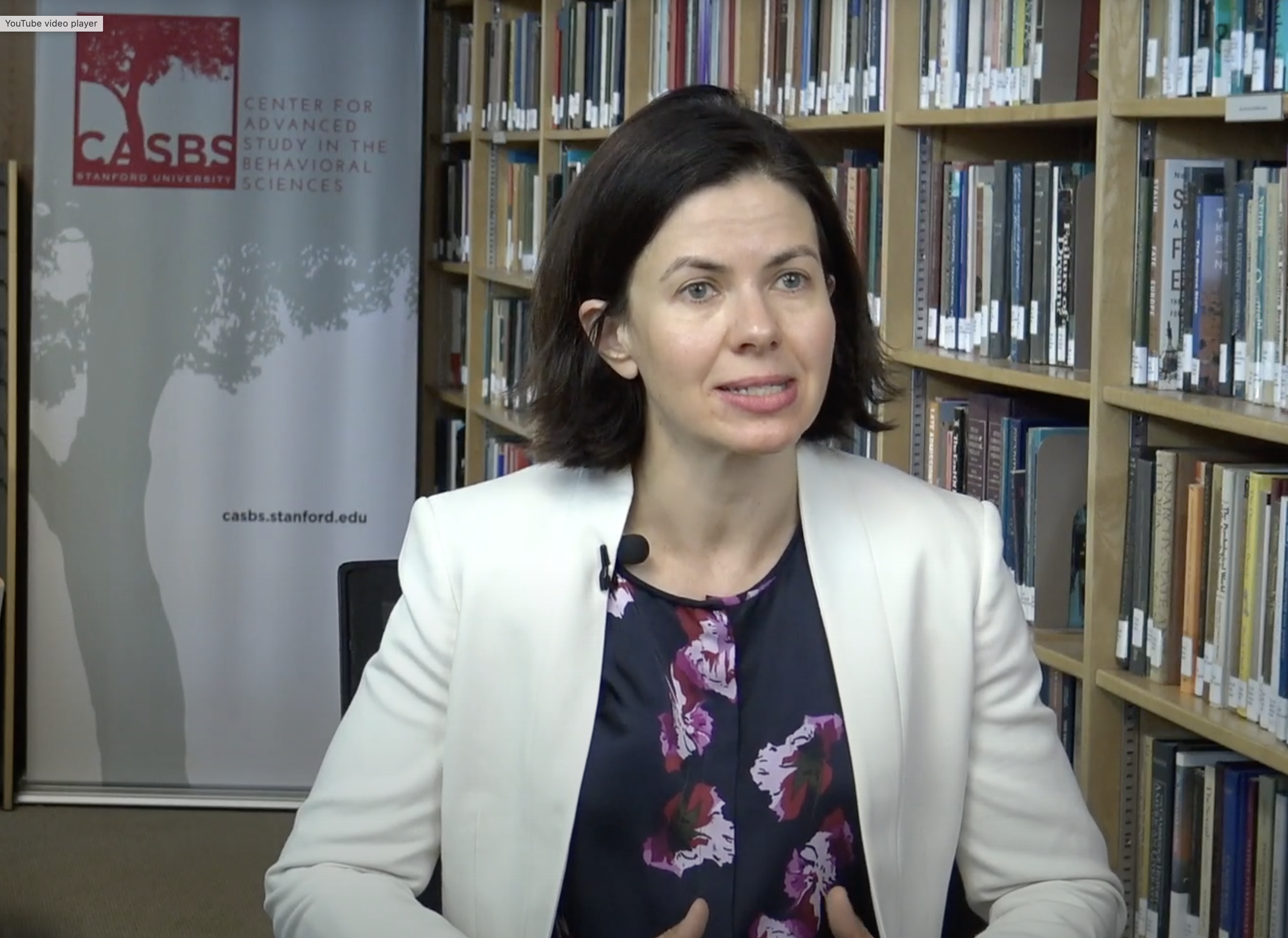
Katerina Linos is Michael Heyman Professor of Law at the UC Berkeley School of Law and Co-Director of the Miller Institute for Global Challenges and the Law.
She is the author of The Democratic Foundations of Policy Diffusion: How Health, Family and Employment Laws Spread Across Countries (Oxford University Press, 2013). In the book, she documents that laws don’t spread only through expert networks, but also through popular movements. Politicians can win elections by advocating for tried-and-true, mainstream models. Therefore, the same law is often adopted around the world, even in countries for which it is a poor fit.
Linos also studies how information and misinformation shape refugee and migration law. In Digital Refuge, Linos presents the European refugee crisis from the perspective of migrants, drawing on thousands of interviews and Facebook posts.
Linos has researched how the media translate US Supreme Court, opinions and how public opinions cleavages form around the world (from the European Union to the UN General Assembly).
Linos’ research is empirical and focused on developing and applying innovative qualitative and quantitative methods. Her work appears in leading law reviews and peer-reviewed journals, including the American Journal of International Law, the American Journal of Political Science, the American Political Science Review, the California Law Review, the Chicago Law Review, Comparative Political Studies, the European Sociological Review, and International Organization. Linos is the host of the international law podcast Borderlines, through which she is creating a joint archive of judges’ biographies with the Court of Justice of the European Union. As a 2024-25 CASBS fellow, she is researching how the EU develops comprehensive initiatives rapidly in the fields of technology, finance and migration.
Books & Ideas: As a specialist in international law and international organizations, how would you describe the current moment in light of Trump’s repeated attacks on international organizations in general, and the UN in particular? Is the same dynamic at play with the EU?
Katerina Linos: Let me start with the United Nations and the Trump administration. I’ll continue with the EU. But I do think we see two very different patterns. The Trump administration is destroying American participation in international institutions as well as the federal government. For these reasons, this public good the US has been providing will decline. Others will step in where the US is stepping aside, but the world will not be the same.
I am very concerned about the cuts to US agencies like USAID, but also to the agencies that don’t make the headlines, like, our efforts to fight climate change in a much quieter way. I expect those to fall behind. I’m very concerned with the role the US is playing right now in international organizations.
That said, because President Trump is not the first to be hesitant towards global leadership, there have been workarounds for decades. Some of my work with Kristina Daugirdas is about efforts the Bush administration made to sidestep international organizations, to set up coalitions of the willing not only for Iraq, but also for global banking to fight Aids and to deal with other projects they thought the UN was handling too slowly.
So there have been networks, there have been other institutions, because President Trump illustrates a problem with US leadership that has been present for a while.
In my view, the situation with the EU is completely different. I would not have said the same thing five years ago. Nine years ago, the UK voted for Brexit.
We had a really big moment of crisis. Other crises had preceded that: the financial crisis in 2009, 2010, the refugee crisis peaking in 2015, 2016. There were many questions about whether the European Union would be able to handle these crises effectively, whether the Brussels bureaucracy was too remote, whether the Brits would be followed by other member states. That is not where we are today in the European Union.
The Brits themselves regret their vote. Nationalists around Europe have decided that exit from the union is not the strategy they will pursue. Some of them, like the Italians, are working very closely with EU leadership. Others, like the Hungarians, are fighting Brussels tooth and nail but at the same time are not proposing exit. I believe that the Covid response of the European Union was phenomenal.
I believe that the EU is coming together to handle crises like Ukraine in ways we had never seen before. And just to connect to the first portion of the question, one of the ways in which the US is weakening international organizations is by reducing their budget and not contributing on time. The budget of the European Union increased dramatically after Covid through the Next Generation EU program.
There are proposals to make that change permanent and further increase it. I see the EU as banding together at this very difficult moment.
Books & Ideas: How do you explain the “unpopularity” of bureaucracy?
Katerina Linos: I think that international organization bureaucrats vary. When we had Covid, some managed to update their websites and that was it. Others pulled together major transformative projects to finance not only vaccine distribution and production, but also responses to closed borders, to unemployment and immigration. So I think there is a huge variety, and some of the best people in some countries are attracted by the vision of international organizations, by the prospects of advancing in these organizations.
I would say that the quality of international bureaucrats varies and is very high again, in the European Union, as well as in some of the more technical international organizations. The quality of staff in the IAEA (International Atomic Energy Agency) or in the World Bank, or in the WHO (World Health Organization), I think is, quite high. Same for UNHCR (United Nations High Commissioner for Refugees), the UN refugee agency. I think, international organizations have some great people but they don’t always advertise them.
Unicef is very, very popular, in part because they have high quality people and in part because they talk about their mission right and left. If your mission is to prevent nuclear catastrophe, better that you not be in the news day and night. That said, I do some work on polling and international organizations, and how a group such as American Republicans, who’s traditionally been skeptical might nevertheless be persuaded.
And I think they’re talking about what everyone does, what is the international norm and how their community might not meet that international norm can be persuasive. I think people don’t think about international organizations on a day to day basis. But groups that have negative views, in part because they’re not necessarily very familiar, might change those views in response to an experiment.
In contrast, liberal Democrats will already believe, and these organizations might not change their minds that much.
Books & Ideas: What are the conditions required for diffusion and compliance with international law?
Katerina Linos: I’ll start by talking about my work on the diffusion of ideas, as I found that it’s really key, not only for bureaucrats to be persuaded that a solution is technically correct, but for politicians to campaign and persuade ordinary citizens that a shift is necessary. In my first book, The Democratic Foundations of Policy Diffusion, I spoke about how politicians would often make the following argument: “Everyone is doing this. We should do it too, we’re the only country in the world that doesn’t have maternity leave. We’re the only country in the world that doesn’t have high quality, affordable health care.” And they did this in part because voters are so skeptical of politicians. Voters are skeptical that politicians will put in place radical ideas. Voters are skeptical that politicians will try to enrich their allies and harm everyone else.
When politicians point to international organization templates, point to a widespread diffusion of certain norms, then that can make their argument more persuasive. Part of my research focused on the diffusion of ideas through electoral politics, on why politicians in around the world, but especially on the European periphery, were able to point to models by the UN, models by the EU, models by Central and Western European countries to say “our entire society will move forward, I am not trying to enrich my special friends. I’m not trying something radical. A tried and true proposal is out there and we need to adopt it.” This resonates broadly with American audiences and especially with audiences on the European periphery. So I believe that, the diffusion of ideas can be used for good and can be used for bad. Most ideas that spread and end up being average to good, but sometimes ideas that I don’t approve of spread through this method.
And this brings me to the question of refugees and immigration policy. A European idea in the late 1980s, was the idea that the first safe country through which refugees transit, need to have some responsibility for processing that asylum claim. In the 1980s, the Italians were seen as irresponsible for allowing people to move to Italy and to France. And in 1990, the Dublin Convention was signed, making countries on the European periphery responsible to process asylum claims. That idea is a fundamentally conservative idea. UNHCR had seen that idea at the time and were shocked, arguing that there’s no relationship between a country through which a refugee or an asylum seeker is simply transiting through, and responsibility for that claim.
But that idea has now become mainstream and has been adopted by radical governments, first in Australia, then in the United States. So ideas spread, and I’m delighted that the new migration pact that the Europeans agreed on in March 2024, revises this idea and says countries of transit are often countries that face very large numbers of people. That is bad for the countries, but it’s especially bad for people who have to wait, often in detention-like conditions while their claims are processed. Let’s think about what we do in crises. Let’s think about how we redistribute some of that responsibility. And that is a model that has passed with lots of controversy internal to the EU.
It’s just applicable for the 27 member states. But it could spread globally because this question of responsibility sharing is one that is especially important to the developing world, where most of the world’s refugees are living. It was very important in discussions in the Global Compact in 2018, and I would like to see some of that revision to the first safe country principle be uploaded to the world of ideas and spread globally.
Books & Ideas: What is the project Digital Refuge and why are migrants’ and governments’ narratives so different?
Katerina Linos: I’m delighted to talk about Digital Refuge. The website is digitalrefuge.berkeley.edu, because it’s the most ambitious project I’ve been able to complete today. It is a project that collects information from Facebook sites, from thousands of interviews that NGOs conducted, and from interviews my team and I conducted to retell the story of the Syrian and Afghani refugee crisis in Europe in 2015, 2016, 2017.
There was an official narrative for that story, namely that Europe mishandled that crisis in 2015 and that the crisis ended in 2016, when Europe signed an agreement with Turkey. We stopped paying attention. The news media stopped covering the crisis after that date. My team and I so 18 staff and students, as well as the NGOs with which we partnered, were able to compile a very a lot of information. So thousands of interviews and synthesize it and put it on a website and analyze it in a variety of ways. All of these stories we know take a dark turn, that march. Refugees themselves are much less optimistic after the EU-Turkey deal. They don’t stop worrying about the problems. They just are no longer on the Western news media.
And this is why I’m so proud of this work. It is work that allows any researcher, any student to go on the website and to do analysis themselves by using very simple filters. If you wanted to compare the Syrians to the Afghans, if you wanted to look at one island rather than another, if you wanted to see if young boys are different from young girls.
We have pulled together a lot of information and made it very accessible, translated it into several languages, both European languages, Farsi and Arabic. It is a testament to a very different narrative about that migration crisis.
Books & Ideas: Based on your Borderlines podcast series, which has been interviewing, judges and advocates, in the European Union, what can you tell us about the way the European bureaucracy works?
Katerina Linos: I’m absolutely delighted to have had the opportunity to work on some major projects while at CASBS. One of them is the Border Line CGU archive. For a number of years, I’ve been posting interviews with international law academics and judges, and I’m able to collaborate with my coauthor, Mark Pollack, our fabulous producer, Toni Mendicino, with the Court of Justice itself, so that we can interview as many of the judges on the Court as possible.
Now, this is a court that is not covered in the national news media or the international news media on a regular basis. Here in the US, when Justice Alito’s wife has a feud with her neighbor, that’s national news. But they are the judges themselves, people who have often risen from the top layers of the national judiciary, so people who used to get a lot of publicity back home are suddenly in Luxembourg, and no one is paying attention, even though their decisions are very, very consequential.
I think it’s a geography problem. I think it’s a media problem. I think it’s a $20 bill that was waiting for us to be found because the new president of the court, President Lenaerts, is very interested in media. We were able to interview 25 judges and advocate generals because there’s turnover on the court, and we’ve posted the first ten interviews. More should be available and I love that scholars and students of EU law don’t have to read 400-word cases written by committees that can be quite cryptic, but can hear from the judge who was the reporting judge on the opinion that the important paragraph is paragraph 45, and what makes it important is what was not included, rather than what was included.
I think this is a tremendous resource. And on the website, we have the interview. When we have all of these links to speeches, to the primary documents, I am very excited, by this project. That’s one of the projects I’ve put in place that others have been translating into Romanian and Greek and other languages I hadn’t previously been able to work with. So that’s the Borderlines project, the archive in particular, where the Court of Justice has been a real opportunity for me to talk to some of the world’s leading jurists.
Now, there’s a moment of pessimism here in the US. I think a lot of people are disappointed by what the Trump administration is doing on a daily basis, and we hope to look to places where things seem to be working, where trains seem to be running, where a new project seems to be implemented, and the optimism that comes with the European Union is one of the reasons why I’m working on a book. It’s tentatively titled From Brexit to Breakthrough. Again, because I don’t think anything was predetermined. I think the response to the Ukraine crisis, for example, where Europe put in place a lot of energy policies through emergency procedures, a lot of financing policies, a lot of our policies to host Ukrainians just days after Russia invaded was not anticipated by the experts, by the bureaucrats.
I think there has been a positive shock. I think bureaucrats in Brussels were able to take advantage of this window of opportunity. One of them told me, “we’re able to act so fast because we have a lot of plans in the freezer. We just take them out of the freezer and we microwave them when the right moment comes”.
And I have seen a transformation in finances which now rely on much more solid arithmetic than prior budgets. I have seen a transformation on sharing responsibility for asylum seekers at a moment when national publics are very conservative and right when governments are in power, including far right governments in many member states. I do see this moment as a moment of opportunity for the European Union. Olaf Scholz called it the Hamiltonian moment. And I think this is what is happening. The European Union is coming together in a way it had not before, and provides us with this beacon.
Books & Ideas: What about the geography of these institutions ?
Katerina Linos: I have often wondered whether accidents of history have played a key role. Following World War Two, there were big fights over where the UN would be headquartered, where the European Union institutions would be placed. The European Union’s institutions could not be put in Berlin or Rome for that matter, because of who won World War Two. But states were wary to put them in Paris.
So instead the European Union institutions were put in Brussels, Luxembourg and Strasbourg, which are relatively remote locations . For this reason, I think people spending their careers in these locations end up interacting less with interest groups, end up being less susceptible to pressures from lobbyists. There is less of a revolving door problem when you know that your career will be consistently in this institution and far from national politics.
And I think that more radical ideas, are allowed to flourish. They’re not killed the moment they’re born by somebody who expects that this will never pass, this will never go through. So I do think that that location of these institutions and the career incentives of people in the commission and the court are fascinating. To me, what’s even more fascinating is the European Parliament, people elected on rightwing platforms, that’s the majority of the parliament, consistently vote to the left of the commission on any measure of politics.
It is fascinating to me how people take on their institutional roles. They think about themselves as the Parliament, the protector of rights and as a result vote for more EU integration, vote for more protections of human rights, than you would expect based on the parties that they’re elected from.
To me, the hardest thing to pull together is not centralization. The EU has moved lots of issues from the member states to the center. But to ask, how is it possible for German taxpayers to want to support unemployed workers in Italy or Spain? That to me is the true measure of a union. And that has happened. So, Next Generation EU, half European Union budget for the 21st century, for the current period, is a project that is remarkably transparent and remarkably redistributive.
Next generations of German taxpayers and of all taxpayers are paying for immediate expenses post-Covid and for investment in climate change and the digital transformation in countries that are most in need. Some countries are receiving 1% of GDP, Italy and Spain, about 10% of GDP for Greece it was 20% of GDP. These are shocking numbers and I am very pleased and very surprised with the size and nature of this project.
The EU budget had always had a little bit of a redistributive character. We had the regional funds designed to support areas of Europe that were more remote, a big investment in agricultural policy that allowed farmlands across Europe to remain farmlands. But the new budget is much more redistributive, and that solidarity is what might help hold the European Union together. I am very impressed that this happened.
by , 14 November 2025
Share this article
Find us here :


To quote this article :
Marieke Louis, « Expanding International Bureaucracy . Interview with Katerina Linos », Books and Ideas , 14 November 2025. ISSN : 2105-3030. URL : https://laviedesidees.fr/Expanding-International-Bureaucracy
Nota Bene:
If you want to discuss this essay further, you can send a proposal to the editorial team (redaction at laviedesidees.fr). We will get back to you as soon as possible.
You might also like


Our partners


Sections
Keep in touch
© laviedesidees.fr - Any replication forbidden without the explicit consent of the editors. - Mentions légales - webdesign : Abel Poucet